Between the sorting of organic waste, which has become mandatory since January 1, 2024, and the new constraints on food packaging, cooking for loved ones is no longer just about choosing a delicious recipe. Managing leftovers, selecting storage containers, and organizing meals for the week form a set of decisions that weigh as much on taste as on budget.
What concrete levers allow us to reconcile pleasure at the table and reduce food waste on a daily basis?
Food waste in the kitchen: what leftovers reveal about our habits
Domestic food losses remain a blind spot in everyday cooking. The confusion between the expiration date (DLC) and the minimum durability date (DDM) leads to throwing away products that are still consumable. A yogurt that is a few days past its DDM does not pose the same risk as meat that is beyond its DLC.
The source sorting of organic waste, generalized since January 2024, encourages us to take a closer look at what ends up in the trash. Vegetable peels, chicken carcasses, carrot tops: these often-neglected items form the basis of broths, pestos, or homemade chips.
On the cooking page of Gourmandises et Cie, you can find approaches that integrate this logic of valuing leftovers into accessible recipes, without turning the meal into an accounting exercise.
| Common Waste | Valuation Recipe | Preparation Time |
|---|---|---|
| Radish or carrot tops | Top pesto (blended with oil, garlic, parmesan) | Less than 10 minutes |
| Stale bread | French toast, homemade breadcrumbs, croutons | 5 to 15 minutes |
| Chicken carcass | Chicken broth (base for soups, risottos) | Variable (long cooking) |
| Potato peels | Baked peel chips | Less than 20 minutes |
| Wilted vegetables | Velouté, gratin, or sautéed | 15 to 30 minutes |
This table highlights a simple point: most leftovers can be transformed in less than 20 minutes. The barrier is not technical; it is organizational.
Weekly menu: planning meals to cook less and better
Weekly meal planning remains the most effective lever to limit unnecessary purchases. Preparing a weekly menu allows you to cross ingredients between several recipes: a roast chicken on Sunday gives broth on Monday and a composed salad on Tuesday.
Building a menu around three families of ingredients
Rather than starting from isolated recipes, the most economical method is to choose three proteins (chicken, lentils, eggs for example), two or three starches, and to complement with seasonal vegetables available. Crossing ingredients between meals reduces the volume of purchases without impoverishing the variety of dishes.
A vegetarian dish based on lentils on Wednesday uses the same onion, the same broth, and the same spices as a chicken curry planned for Friday. The gain is not only measured in euros: it is also time freed up in shopping and preparation.
Adapting portions to avoid excess
Waste due to excess portions represents a significant share of losses at home. The distinction between a meal for four people and a meal for four hungry adults significantly changes the quantity of starches.
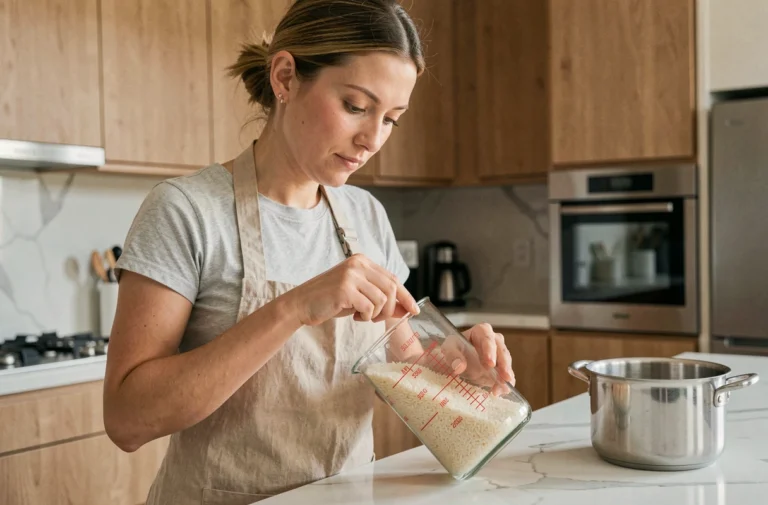
- Weigh pasta and rice before cooking (a simple guideline: count the size of a closed fist per guest for rice) rather than pouring by eye into the pot
- Label leftover containers with the preparation date to consume in order and avoid forgetting them at the back of the refrigerator
- Freeze excess portions on the same day instead of storing them in the fridge for three days hoping to finish them
A labeled and frozen leftover on the same day is consumed; a forgotten leftover is thrown away.

Storage and food containers: what changes with regulations
Increasing restrictions on certain substances in food contact packaging accelerate the shift towards the reuse of containers. For home cooking, this evolution has a direct consequence: the choice of storage container influences the shelf life and taste quality of dishes.
Reheating a gratin in a glass dish rather than in a plastic container is not just a regulatory issue. Glass better withstands temperature variations, does not retain odors, and cleans without residue. On the other hand, food-grade plastic remains lighter for transport and freezing.
What container for what use in daily cooking
- Glass with airtight lid: ideal for soups, sauces, and dishes to be reheated in the oven. Lasts a long time, dishwasher safe without alteration
- Stainless steel: suitable for transport (lunch box), does not break, but is not microwave safe
- BPA-free plastic: acceptable for freezing, to be replaced as soon as it shows scratches or deformities
- Reused glass jars: zero-cost solution for storing dry legumes, spices, or leftover compote
Favoring glass for refrigerator storage allows you to visualize the contents and limit forgetfulness, the primary factor of domestic waste.
Seasonal gourmet recipes: three axes to vary pleasures
Cooking seasonally does not just mean buying squash in the fall. Choosing seasonal vegetables naturally guides you towards different cooking techniques: roasting for roots, quick cooking for spring green vegetables, raw for summer tomatoes.
Chicken, the most versatile protein in family cooking, illustrates this logic well. Roasted whole on the weekend, it can be shredded for wraps the next day, then made into broth for a risotto midweek. One chicken can cover three distinct meals without boring the diners.
Vegetarian dishes also benefit from being thought of by key ingredient rather than by recipe. A batch of cooked chickpeas at the beginning of the week serves for hummus on Monday, a composed salad on Wednesday, and a curry on Friday. This ingredient-based approach, rather than dish-based, transforms the constraint of the weekly menu into a combinatorial game.
Cooking gourmet meals for loved ones ultimately comes down to a few concrete trade-offs: planning without rigidity, storing properly to avoid loss, and treating each leftover as the starting point for the next meal rather than as a waste waiting to happen.