The measurement of rice is rarely done to the exact gram, but recurring mistakes stem from a reflex: reasoning in gross weight without considering the composition of the meal or the specific cooking behavior of each variety. Here we propose an approach that goes beyond the simple guideline of 60 g per person, often repeated without context.
Expansion coefficient and apparent density: what the measuring cup doesn’t tell you
A cup of uncooked basmati rice and a cup of uncooked round rice do not produce the same cooked volume. Basmati, a long and narrow grain, leaves more air between the grains. Its bulk apparent density is therefore lower than that of round rice or sticky rice, whose grains fit together better.
In practice, the expansion coefficient varies depending on the variety and cooking method. Long-grain white rice absorbs less water than brown rice, which requires a significantly longer cooking time and a greater volume of water. The guidelines of “half a cup per person” work correctly for classic white rice but underestimate the final portion of brown rice or risotto rice, which absorb liquid differently.
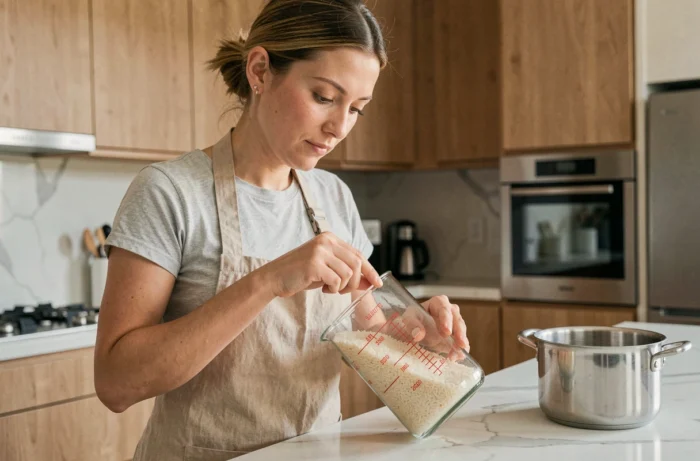
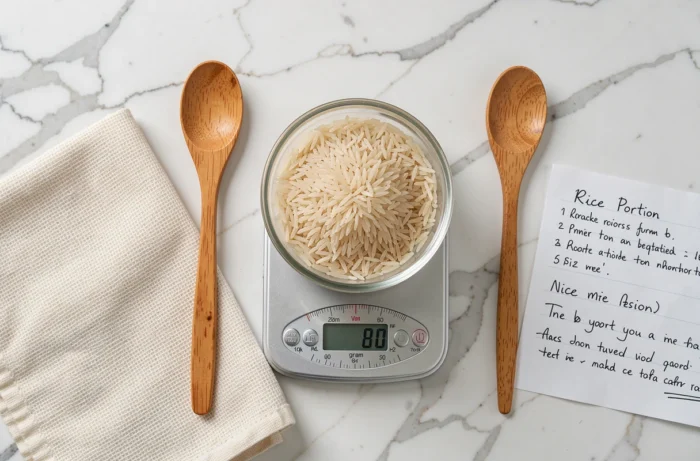
We recommend calibrating the first time with a scale, then transferring the measurement to the usual container (glass, mug, cup) to create a reliable reference suited to the variety you use most often. You can read on the blog Les Coudes sur la Table for additional references on this calibration by container.
Measuring rice according to the actual composition of the plate
Measuring rice without looking at the rest of the plate systematically produces an imbalance. The portion of rice depends on the space it occupies in the meal, not on a fixed number applied to every situation.
Rice as a side dish with vegetables and proteins
When rice makes up only a quarter of the plate (the rest being occupied by vegetables and a source of protein), the raw portion per person drops significantly below the standard guideline. A sedentary adult does not need the same amount as an athletic teenager, and the presence of another carbohydrate (bread, potatoes in a mixed salad) justifies further reduction.
Rice as the base of the dish: risotto, fried rice, paella
When it constitutes the main part of the dish, rice should be measured upwards. A risotto, for example, absorbs a significant amount of broth: the weight of uncooked rice per person for a risotto exceeds that of a simple side dish. The same logic applies to fried rice or paella, where the grain is the main carrier of flavors.
- Classic side dish (quarter of the plate): moderate raw portion, to be adjusted downwards if another carbohydrate is present.
- Complete dish based on rice (risotto, paella, fried rice): increased raw portion, with rice providing most of the satiety.
- Rice salad or gratin: intermediate portion, with rice sharing volume with vegetables, sauce, or cheese.
This reasoning based on plate composition is more reliable than a single weight measurement, as it automatically adapts to the day’s menu.
Whole grain rice and absorption cooking: two underestimated variables
Whole grain rice is a particular case that general dosage guides rarely address. Its longer cooking time and higher water requirement alter the raw/cooked volume ratio. Directly transposing the guideline from white rice to whole grain rice leads to under-measurement of water and insufficiently cooked grains.
The cooking method also plays a direct role in the final quantity. The pilaf cooking method (by absorption) retains the starch in the grain and produces denser and stickier rice than cooking in a large amount of water followed by draining. This latter technique, in addition to altering the texture, helps reduce the inorganic arsenic content of the grain, a point raised by several health authorities in recent years.
For a rice cooker, the water/rice ratio is generally calibrated by the manufacturer, but it assumes standard white rice. With whole grain or semi-whole grain rice, we find that the water level needs to be adjusted above the indicated guideline and the cooking time extended.
Adjusting the amount of rice for specific audiences
A standard measurement does not cover all situations. Needs vary greatly depending on the eater’s profile and the context of the meal.
- Children under six years: reduced portion, and prefer rice cooked in a large amount of water to limit exposure to inorganic arsenic, in accordance with health authority recommendations.
- Athletes or physically active workers: increased portion, as rice then serves as a quick energy source to replenish glycogen stores.
- People monitoring their glycemic intake: prefer basmati rice or whole grain rice, which have a lower glycemic index than round white rice, and adjust the portion downwards.
Measuring rice according to the eater’s profile avoids waste as well as frustration. A family meal involving a child, a teenager, and two sedentary adults cannot be measured with a single multiplier.
Managing leftovers and food safety of cooked rice
An approximate measurement almost always produces leftovers. Cooked rice is a favorable environment for the development of Bacillus cereus, a bacterium that proliferates rapidly at room temperature. Cooked rice must be refrigerated within an hour of cooking, in a closed container, and consumed within 24 hours.
Reheating rice only once, to the core, remains the basic rule. This food safety point is directly related to the measurement: it is better to prepare slightly less and supplement with another food than to store poorly preserved leftovers.
Measuring rice is best treated as a technical gesture rather than a rough approximation of quick cooking. The variety, cooking method, plate composition, and guest profiles form a set of parameters that, once integrated, make the scale almost unnecessary in daily life.