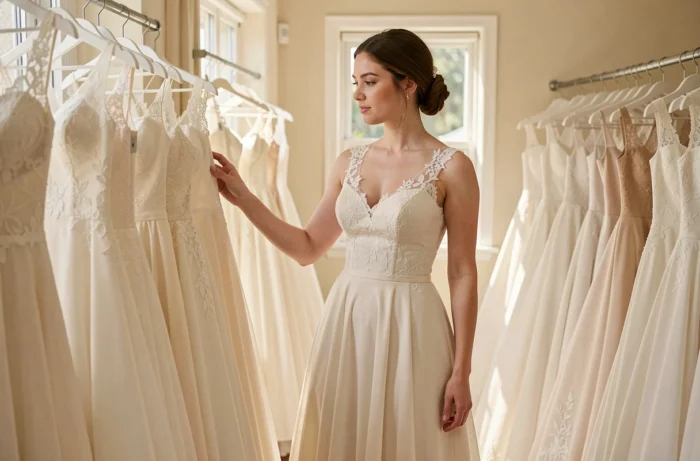
The choice of a wedding dress is not made in the emotion of a fitting room. It is prepared in advance, with a technical reading of one’s own silhouette, an understanding of materials, and a fitting methodology that goes far beyond the love-at-first-sight moment in front of the mirror.
Functional tests during fittings: the method that replaces the love-at-first-sight
We still observe too many brides who approve a dress solely based on the static reflection in the fitting room. According to Gigi Beauty, fittings benefit from incorporating functional tests that mimic the actions of the big day: walking, sitting, climbing a few steps, raising arms, dancing, and breathing deeply.
These movements reveal what a mirror does not show. A bodice that slips after three steps compromises the entire day. A corset that is too tight compresses the diaphragm, making meals uncomfortable. A train that catches on every half-turn turns the dance floor into an obstacle course.
We recommend scheduling at least two distinct fitting appointments, spaced a few days apart. The first is for pre-selection, the second for cold validation, checking comfort, mobility, and budget coherence. Professionals like those listed on perlemaisondemariee.fr support this approach by structuring fittings around technical criteria rather than emotional ones.
Fabric weight and skirt construction: what changes real comfort
The 2025-2026 collections mark a shift towards lighter dresses, with fewer layers, less petticoats, and fewer heavy embellishments. This trend is not just aesthetic: reducing the volume of the skirt frees up mobility and limits fatigue on a reception day.
The choice of fabric directly affects how the dress fits on the body and its breathability. Here are the parameters to evaluate before approving a material:
- The density of the weave: a mikado or thick crepe structures the silhouette without needing additional boning, while a fine organza requires a petticoat to hold its shape.
- Breathability: for a summer wedding, lightweight tulle or chiffon allows for better air circulation than a lined satin, which retains heat.
- Wrinkle resistance: a dress worn for more than ten hours must withstand creasing, especially at the seat. Crepe and mikado significantly outperform wild silk in this criterion.
- Total weight once assembled: a layering of lace over tulle over lining can reach a substantial weight, which the bride does not perceive during a twenty-minute fitting.
Asking the seamstress for the exact number of layers and the type of integrated petticoat is a technical reflex that avoids many disappointments on the big day.
Silhouette and morphology: reading proportions rather than size
The size on the label says nothing about the cut suitable for a body type. What matters is the ratio between shoulder width, waistline, and hip volume.
An A-line silhouette, common, is characterized by shoulders that are narrower than the hips. A trapeze cut or empire line visually balances proportions by drawing the eye towards the bust. Conversely, a V-shaped silhouette (broad shoulders, narrow hips) benefits from being dressed in a voluminous skirt, like a princess style, to create a lower counterbalance.
The trap of the mermaid cut on a short morphology
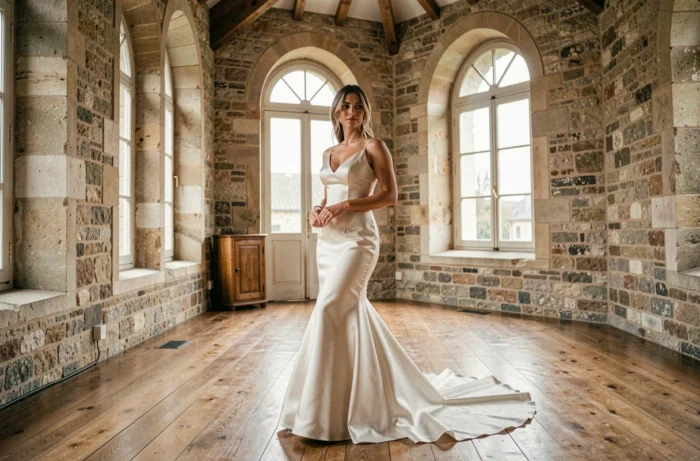
The fitted mermaid cut down to the knee before flaring works on elongated silhouettes. On a short bust or proportionally shorter legs, it compresses the silhouette and restricts movement. We advise against this cut without a fitting with shoes at the final height.
The neckline plays a structural as well as aesthetic role. A V-neckline elongates the bust, while a straight bodice visually widens the shoulders. These optical effects can be verified in the fitting room, but only if the bride wears the technical undergarment she will wear on her wedding day.

Alterations and custom fitting: anticipating actual production timelines
Choosing a dress is just the first step. The alteration phase, often underestimated, determines the final drape. An ill-calibrated hem of a few millimeters alters the entire line of the skirt. A bodice taken in too tightly creates unsightly wrinkles in profile photos.
Ordering your dress at least ten months before the wedding remains the recommendation of the bridal couture industry. This timeframe covers production (particularly lengthy for custom pieces), the two to three necessary fitting sessions, and a safety margin in case of body changes.
Alterations are not limited to length. They include adjusting bust darts, tensioning straps, repositioning a back lacing, and sometimes adding additional boning to reinforce bust support. Each intervention alters the balance of the dress and justifies a control fitting after each visit to the workshop.
Alteration budget: a line item to include from the start
The price displayed in the store generally does not cover alterations. This item represents a significant portion of the total budget. We recommend requesting an alteration estimate upon ordering, to avoid an unpleasant surprise a few weeks before the ceremony.
A technically well-fitted dress is immediately noticeable in photos and, above all, is felt throughout the day. The comfort of a bride who can breathe, dance, and sit without constraint is reflected in her posture and smile, much more than in the choice of lace or veil.