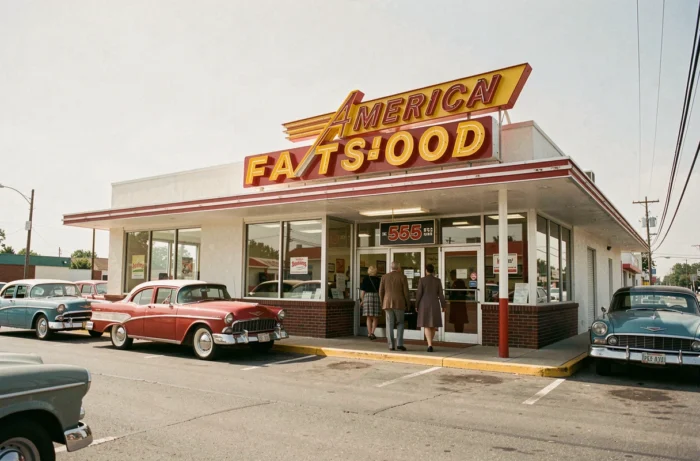
Two burger giants share the streets of almost every French city. Their rivalry has fueled conversations for decades, but one question often arises: McDonald’s or Burger King, which opened its doors first? The answer lies about fifteen years apart, and the story behind this lead sheds light on many strategic choices that still shape the fast-food industry.
The drive-in in San Bernardino, the birthplace of modern fast food
Before becoming a multinational, McDonald’s was a small drive-in restaurant. Brothers Richard and Maurice McDonald opened it in 1940 in San Bernardino, California. The initial concept resembled dozens of other American roadside establishments.
What changed the game was their decision to radically simplify the menu and organize the kitchen like an assembly line. Fewer dishes, standardized preparation, ultra-fast service. This system called Speedee Service invented fast food as we know it.
Burger King, on the other hand, only appeared in 1953 under the name Insta-Burger King in Jacksonville, Florida. The brand took its final form on December 4, 1954, in Miami. To know precisely who opened first McDonald’s or Burger King, we must go back to these founding dates: McDonald’s precedes Burger King by about thirteen years.
McDonald’s in France since 1979: a head start in the French market
The gap between the two brands is not limited to the United States. In France, McDonald’s opened its first restaurant in 1979 in Strasbourg. The country then discovered the hamburger served at the counter, in a standardized American format.
Burger King also tried its luck in France, but its initial establishment was short-lived. The brand left French territory and only truly returned in the early 2010s, through the gradual acquisition of Quick restaurants. This massive return spanned several years.
Today, McDonald’s France has over 1,500 restaurants. Burger King France, for its part, aims for more than 600 restaurants by 2026. The historical lead of McDonald’s is also reflected in a significantly denser territorial network.
Why this gap widened in France
McDonald’s benefited from nearly three decades without direct competition from Burger King on French soil. During this time, the brand formed partnerships with local franchisees, adapted its menu to French tastes, and built a solid logistical network.
Burger King had to reconquer a market already structured by its rival. Its strategy of acquiring Quick allowed it to recover existing locations, but the delay in local recognition took time to bridge.
Franchise and concentration: how the fast-food sector has evolved since 2024
The question of precedence is not merely anecdotal. It has direct consequences on the structure of the franchised fast-food market.
Since 2024, a clear trend has emerged in France: the number of franchise networks is slightly declining, but overall revenue is increasing (about a 9% increase in revenue, according to industry data). The market is refocusing on the best-organized brands.
In practical terms, this means that smaller networks struggle to compete against giants like McDonald’s or Burger King, which have colossal marketing budgets and optimized supply chains. The number of outlets is increasing by over 5%, but to the benefit of the major players.
- McDonald’s capitalizes on its historical network and its ability to renew its existing restaurants, often located in long-acquired strategic locations.
- Burger King focuses on rapid expansion and an aggressive pricing strategy, particularly through promotional offers and a menu perceived as more generous in portions.
- Other brands like KFC or pizza chains are also nibbling at market shares, but without reaching the volume of the two burger leaders.
€50,000 tax upon opening: a barrier for new franchisees
A recent element could change the expansion dynamics of the two brands. An amendment to the 2026 finance bill proposes a flat tax of €50,000 for any new fast-food establishment operated as a franchise.
This text has not yet been adopted, but it is under discussion. If passed, it would significantly increase the entry cost for a franchisee wishing to open a new restaurant.
Who would be most affected?
Brands in rapid expansion would logically be more affected. Burger King, which is trying to catch up with McDonald’s in the number of outlets, could see its opening pace slow. McDonald’s, whose network is already mature, would be less impacted since its strategy relies more on renovating existing restaurants than on opening new sites.
This tax illustrates a shift in the public authorities’ perspective on franchised fast food. The sector is increasingly regulated, and the era of unrestricted openings is over.
McDonald’s and Burger King facing new consumer expectations
Beyond the race for the number of restaurants, both brands must contend with evolving eating habits. The burger remains a flagship product, but the demand for transparency regarding products and the origin of ingredients continues to grow.
McDonald’s has taken the lead in this area by communicating for several years about its French supply chains. Burger King responds with ranges that highlight flame-grilled taste, a sensory differentiation argument rather than a logistical one.
The longevity of a brand does not guarantee its future relevance. McDonald’s opened thirteen years before Burger King, established itself in France thirty years earlier, and dominates the territorial network. But the battle is now played out on other fronts: menu adaptation, control of franchise costs, and the ability to meet new regulations. History provides a structural advantage, not a definitive victory.