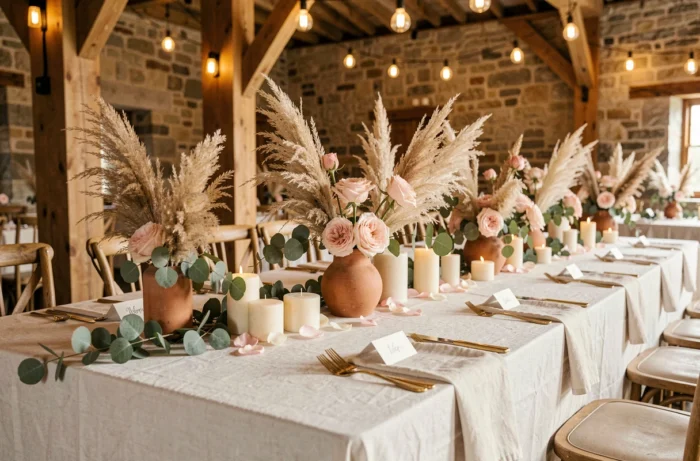
When organizing a wedding in a family home or a private garden, the first constraint is not the theme: it is the venue itself. A low ceiling, a sloping lawn, a wall of exposed stone dictate choices long before the color palette. Starting from the site rather than a Pinterest mood board radically changes wedding decoration, and that is precisely what makes the result more personal.
Curved tables and guest circulation: rethinking the seating plan
Most wedding decor inspirations show aligned rectangular tables or classic round tables. On-site, these configurations often pose problems: too narrow a passage between two rows, guests stuck against the wall, servers weaving through.
Curved tables (oval, serpentine, half-moon) have been gaining popularity for a few seasons. Their interest is not only aesthetic. A serpentine table allows for a natural flow of movement in an L-shaped room or under a narrow tent. Guests face each other at various angles, breaking the rigidity of the classic banquet.
In practical terms, you can find all the decorations on Mariage et Décoration to adapt this type of staging, including table elements compatible with non-standard formats.
The point to check before ordering: the usable width of the curved table. Below 80 cm, centerpieces and plates compete for space. It is recommended to do a full-scale test with cut cardboard in the room before confirming the order with the rental company.
Home wedding decoration: transforming a living space into a ceremony backdrop
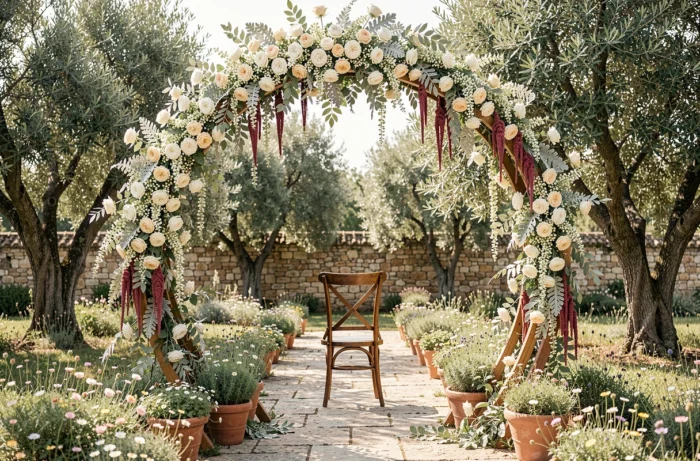
The trend of home weddings is growing in popularity, according to La Demoiselle d’Honneur. It’s easy to see why: no rental fees, a setting rich in family history, and total freedom over timing. However, decorating a living space requires an approach opposite to that of an empty hall.
In a traditional reception hall, you start from scratch and fill it up. At home, you start from existing furniture, garden vegetation, family objects, and subtract what doesn’t fit. The living room sofa can become a ceremony seat with a simple coordinated fabric throw. The old walnut tree in the garden replaces the floral arch.
Three specific constraints to anticipate
- Electrical supply: fairy lights, sound systems, and additional lighting draw from the home network. An electrician should check the capacity of the panel before the big day, to avoid tripping during speeches.
- The garden floor: after a rainy week, a lawn becomes impractical in heels. Plan for paths made of wooden pallets or jute rugs between spaces, which can also serve as decorative elements.
- Neighbors: beyond politeness, some municipalities impose noise regulations. Checking the municipal decree can prevent a police visit at midnight.
Feedback varies on this point, but several couples who have attempted a home wedding report that the decor budget is often lower, provided they do not try to replicate a reception hall decor in a space not designed for it.
Earthy palette and feathers: color choices that change the atmosphere
Pale tones and off-white remain safe bets, but they tend to produce interchangeable weddings. For a few seasons now, earthy palettes (terracotta, moss, caramel) have emerged as a concrete alternative. They work particularly well in stone venues, barns, and gardens, as they complement raw materials instead of covering them up.
Adding feathers to floral arrangements or as hanging elements brings movement without adding excessive volume. A pampas plume in a stoneware vase is inexpensive and creates a centerpiece that does not block the view between guests, a recurring issue with overly tall floral arrangements.
Combining colors without a taste faux pas
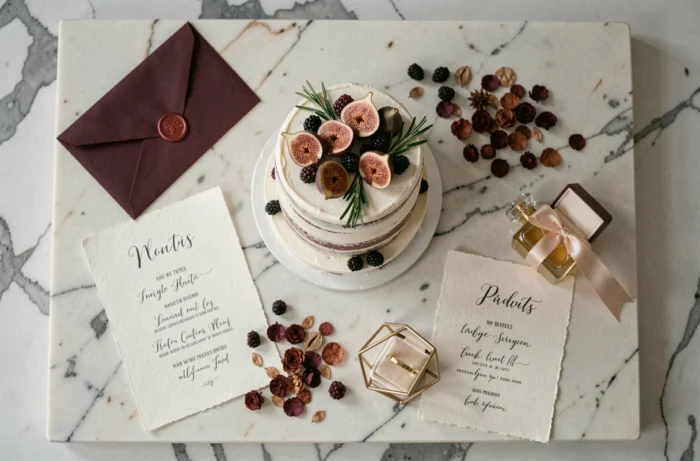
The most reliable operational rule: limit the palette to a maximum of three colors, with one dominant (about two-thirds of the textile and floral surfaces), one secondary, and one accent. Beyond that, the eye doesn’t know where to rest, and visual coherence between the ceremony, cocktail, and reception is lost.
For a vintage theme, aged brass or patinated copper works as a metallic accent. For a more contemporary chic style, brushed steel replaces gold without falling into coldness. The choice of accent metal influences the perception of the entire decor, from the menu holder to the chandelier.
Reception lighting: the detail that shifts the atmosphere
You can invest hours in flowers, fabrics, and stationery, but poor lighting flattens everything. This is the aspect that couples most often underestimate.
Multipurpose room neon lights are the main enemy. If the venue doesn’t have a built-in dimmer, plan for filament bulb fairy lights (like bistro lights) as a supplement, with a portable dimmer plugged into a power strip. The effect changes dramatically between a 2,700 Kelvin bulb (warm, flattering light) and a 4,000 Kelvin bulb (cold, clinical light).
Candles remain the best effect-to-cost ratio. A group of three pillar candles of varying heights, placed on a round mirror, creates a light point per table for just a few euros. Just check that the venue allows open flames, as some estates and tents prohibit them for insurance reasons.
The most successful wedding decoration is not the one that accumulates the most elements, but the one that adapts to the venue’s constraints and the guests’ habits. A fluid seating plan, thoughtfully considered lighting, and a tight palette are enough to create an atmosphere that the photos will faithfully capture, no filter needed.