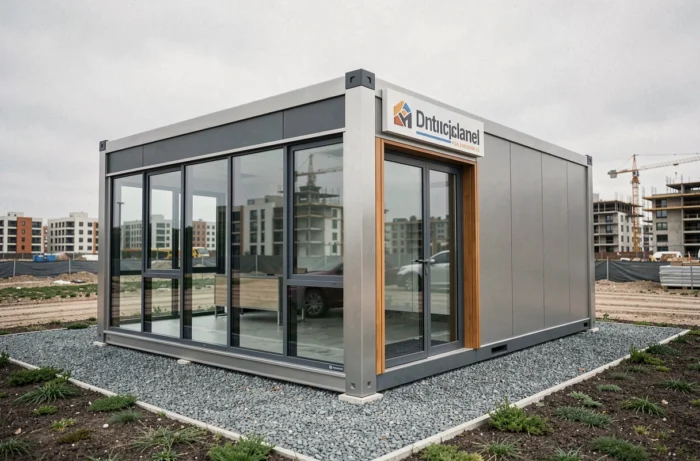
Does a modular sales office installed on-site really generate more signatures than a traditional commercial space rented near the project? The answer depends on several measurable variables: installation time, cost relative to the marketing duration, regulatory compliance, and the ability to create an on-site customer experience. This article compares these parameters to evaluate the actual effectiveness of these structures in real estate sales.
RE2020 regime for temporary sales offices: what the March 2025 update changes
Most content on modular sales offices overlooks the thermal regulatory framework that applies to these structures. The application sheet “Temporary Constructions” of the RE2020, updated on March 14, 2025, clarifies a crucial point for real estate developers.
Sales offices established for a duration not exceeding two years benefit from adapted energy requirements. Specifically, the constraints regarding the envelope, lighting, heating, cooling, and ventilation are relaxed compared to the full RE2020 regime.
For a developer, this means that a modular sales space designed within this temporary framework can be lighter, quicker to set up, and less costly to optimize thermally. However, exceeding the two-year duration shifts the structure into the standard regime, with sometimes significant compliance costs. Anticipating the actual marketing duration of the project thus becomes a strategic decision right from the design phase of the sales office.
For developers looking to combine rapid deployment and compliance, CLE Immobilier’s solutions illustrate how a modular office can adapt to regulatory constraints while serving marketing purposes.

Modular office on-site or rented commercial space: cost and time comparison
The choice between a modular sales office installed directly on the project site and a rented commercial space nearby is based on quantifiable criteria. The table below summarizes the main differences.
| Criterion | Modular office on-site | Rented commercial space |
|---|---|---|
| Time to service | Several weeks (prefabrication in workshop) | Variable depending on availability and renovation work |
| Proximity to the project | Directly on-site, immediate client immersion | Geographical gap, necessary travel |
| Surface flexibility | Adjustable by adding or removing modules | Fixed surface, dependent on lease |
| Commitment duration | Aligned with marketing (often less than two years) | Standard commercial lease (three, six, or nine years) or derogatory lease |
| Reuse | Removable, transportable to another site | None (return of the space) |
| Brand image | Complete customization (signage, barriers, layout) | Owner’s constraints, co-ownership |
The most striking difference concerns surface flexibility and reuse. A prefabricated module can serve successively on two or three projects, amortizing its cost over several operations. A rented space, on the other hand, remains a fixed cost even if the sales pace slows down.
The effect of proximity on the purchase decision
Installing the sales space on the very site of the project allows clients to visualize the real environment: orientation, view, access, progress of the work. This immersion reduces the gap between mental projection and reality, a common barrier in off-plan sales.
Conversely, a commercial space located a few streets away from the site forces the sales team to organize separate site visits, which lengthens the sales cycle and multiplies appointments without guaranteed conversion.
Interior layout of a modular sales office: choices that influence conversion
The structure alone is not enough. The interior layout of a modular office intended for real estate sales meets specific marketing and customer experience objectives.
- Welcome and discovery area: an open space with a physical model or presentation screen of the project, designed to capture attention from the entrance and set the context of the project
- Privatized advisory space: one or more enclosed rooms where the salesperson can go over sales plans, financial simulations, and sign reservation contracts, away from foot traffic
- Representative materials and finishes: floors, wall coverings, and lighting chosen to reflect the range of the sold project, creating coherence between the sales office and the final product
- Connectivity and CRM tools: stable network access to feed a prospect management software in real-time, track follow-ups, and manage the conversion rate by the sales team
A thoughtful layout transforms a simple dressed container into a true conversion tool. Developers who invest in the perceived quality of their sales space generally notice a shortening of the buyers’ decision cycle.
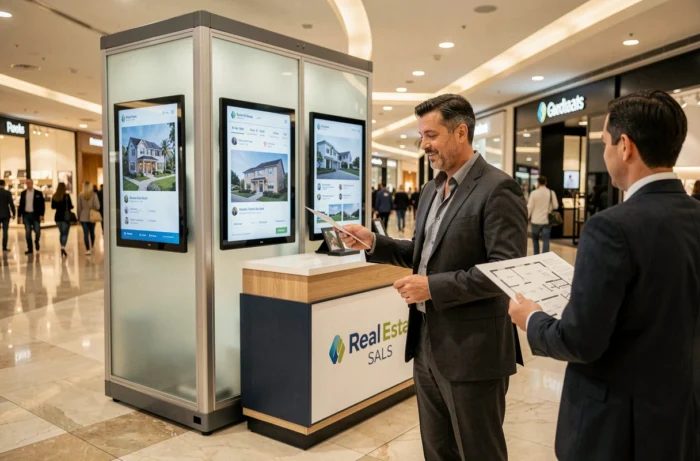
Integration of digital tools in the modular space
3D plans, virtual tours, and apartment configurators take on a new dimension when presented in an on-site sales office. The client moves from the screen to the construction site visible through the window, anchoring the projection in reality.
Coupling a real estate CRM with the physical space also allows tracking the prospect’s journey: first contact, office visit, second appointment, reservation. This data feeds commercial management and helps teams identify friction points in the sales tunnel.
Marketing duration and profitability of the modular office
The profitability of a modular sales office is measured by relating its total cost (manufacturing, transport, installation, layout, dismantling) to the number of lots sold during its operating period. The faster the marketing, the lower the cost per lot.
The temporary RE2020 framework (less than two years) encourages calibrating the size of the office to the projected sales pace. A project of a few dozen lots does not justify the same surface as an operation of several hundred housing units. Modularity allows for this adjustment, by adding or removing elements according to commercial progress.
The ability to move the structure to a new site once the project is marketed represents a financial advantage that fixed solutions cannot offer. This reuse factor weighs heavily in the profitability calculation over several successive operations.
The modular sales office is not just a simple expense item: it is a measurable lever for accelerating real estate sales, provided that the regulatory framework, installation duration, and quality of layout are mastered.