
An unapproved motorcycle is a motorized vehicle that does not have CE approval, which is the document certifying that it meets the technical standards required to circulate on public roads. Typically affected are motocross bikes, pocket bikes, pit bikes, and dirt bikes. Riding this type of machine on the road exposes one to criminal sanctions, but the consequences go far beyond just a ticket.
CE Approval and Registration: What Distinguishes an Approved Motorcycle from a Vehicle Banned on the Road
CE approval constitutes the regulatory foundation. Without it, a motorized two-wheeler cannot be registered, and without registration, it cannot legally travel on any public road, including a communal path or a forest trail open to traffic.
A non-approved vehicle whose speed can exceed 25 km/h by design must still be declared in the DICEM system, even if it does not circulate on the road. This declaration neither replaces approval nor the registration document: it is solely for identifying the owner.
In practice, if the machine does not appear in the vehicle information system with a valid registration number, it is considered an unauthorized vehicle. And any outing on public roads, even briefly (crossing a road to reach private land), constitutes an offense. Obtaining a standard motorcycle insurance for this type of machine remains very difficult, as most insurers refuse to cover a vehicle lacking CE approval.
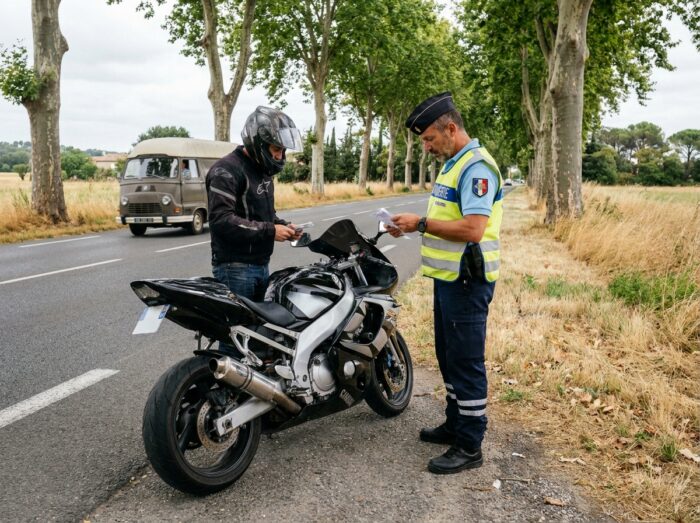
Fines and Criminal Sanctions for Riding an Unapproved Motorcycle
The Highway Code provides several levels of sanction depending on the situation observed during a check.
Circulation on Public Roads Without Approval
The base fine is a fifth-class contravention, the highest level of the fine scale. It may be accompanied by the confiscation of the vehicle, a measure that law enforcement increasingly applies to cross or pocket bike types.
Related Offenses That Accumulate
A roadside check never stops at a single reason. On an unapproved motorcycle, several offenses almost systematically accumulate:
- Failure to register, as the machine cannot have a valid registration document.
- Failure to insure, since no standard contract covers a vehicle without CE approval on public roads.
- Failure to have mandatory equipment (lighting, mirrors, license plate, turn signals) absent on most off-road machines.
Each offense generates its own fine. The total can reach several thousand euros in a single check, not to mention the immediate impoundment of the vehicle and associated costs.
Accident with an Unapproved Motorcycle: The Real Financial Risk
Fines remain bearable compared to the scenario of a bodily injury accident. Without valid insurance, the driver of an unapproved vehicle becomes personally liable for all damages caused to others.
The Guarantee Fund for Mandatory Insurance (FGAO) compensates the victim and then seeks reimbursement from the responsible party. The amounts claimed in cases of serious injury or permanent disability can represent hundreds of thousands of euros, or even more for the most severe damages.
Even when a driver thinks they have coverage, an undeclared modification that renders the motorcycle non-compliant with its original approval can allow the insurer to limit or refuse certain guarantees if the defect played a role in the incident. This point also applies to motorcycles that were initially approved but modified (non-compliant exhaust, engine reprogramming, removal of the catalyst).

Private Land and Recreational Use: A False Zone of Legal Safety
The idea that riding off public roads eliminates all legal stakes is inaccurate. Civil liability also applies on private land, including in a recreational context.
If a third party is injured (a passerby, another rider, a child), the owner of the vehicle incurs liability. Without specific “private land” or “competition” insurance, the costs remain entirely their responsibility.
Some insurers offer contracts dedicated to unapproved vehicles used exclusively off-road. These contracts cover civil liability on private land or on a circuit but expressly exclude any circulation on public roads. The rate remains moderate compared to the risk covered.
Motorcycle Technical Inspection and Risk of Non-Compliance from 2024
Since April 15, 2024, motorcycles and vehicles in category L are gradually subjected to technical inspection, with a schedule extending into 2025 and then 2026 depending on the year of first registration.
For motorcycles that were initially approved but modified, this technical inspection creates a new friction point. An unapproved exhaust, modified lighting, or a frame modification can lead to a refusal during the inspection, and thus a prohibition on circulation until compliance is restored.
This system does not directly concern vehicles that have never been approved (cross, pit bikes), as they cannot be registered. However, it traps owners of road motorcycles transformed for mixed road/off-road use, whose modifications render them non-compliant.
Most Common Cases of Loss of Compliance
- Replacement of the exhaust with a model without CE marking or without an approved baffle.
- Removal or modification of the original catalyst.
- Adding lights that do not comply with regulations (LED bars, additional lights without E approval).
- Engine reprogramming altering the power declared on the registration document.
Each of these modifications, taken in isolation, is sufficient to render the vehicle non-compliant and invalidate insurance coverage in the event of a related incident.
The line between an approved motorcycle and a non-compliant vehicle is thinner than it seems. A single modified part without validation can turn a legal machine into a source of litigation, with financial consequences that far exceed the cost of the modification itself.