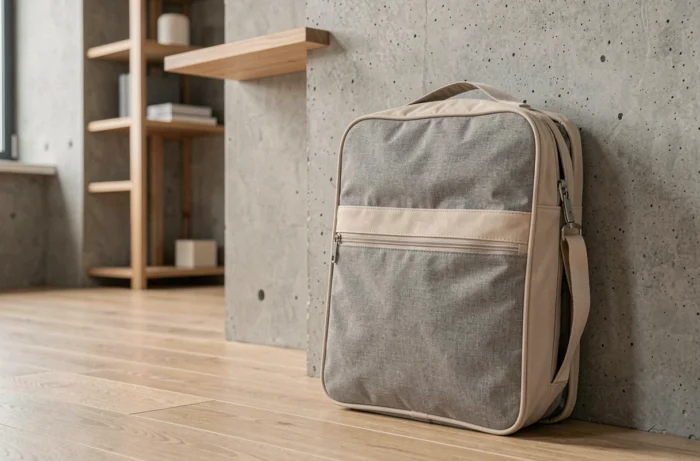
A travel crib intended for a studio, a narrow guest room, or an urban apartment is not chosen with the same criteria as a classic model designed for the trunk of a minivan. The bulk when folded, compatibility with clearance constraints around the sleeping area, and compliance with the latest regulatory requirements become the priority parameters.
EN 716 Standard and Clearance Constraints in Small Spaces
The standard EN 716-1:2017+AC:2019 regulates folding children’s beds regarding mechanical resistance, stability, and load capacity. A point rarely highlighted in consumer guides concerns the maximum allowable gap between the mattress and the structure: it must not exceed 30 mm. Beyond this, the risk of trapping a limb or the face of the infant increases.
In a small space, a second risk arises: the distance between the bed and the adjacent wall. Technical notices compliant with this standard specify that the bed-wall gap must be less than 65 mm or greater than 230 mm. Between these two values, a child can slip and become trapped. Before purchasing, we recommend measuring the intended location and ensuring that one of these two conditions is met once the bed is deployed.
Choosing the compact and lightweight travel crib suitable for your setup therefore requires cross-referencing the unfolded dimensions of the model with those of the room, taking into account this often-overlooked regulatory constraint.
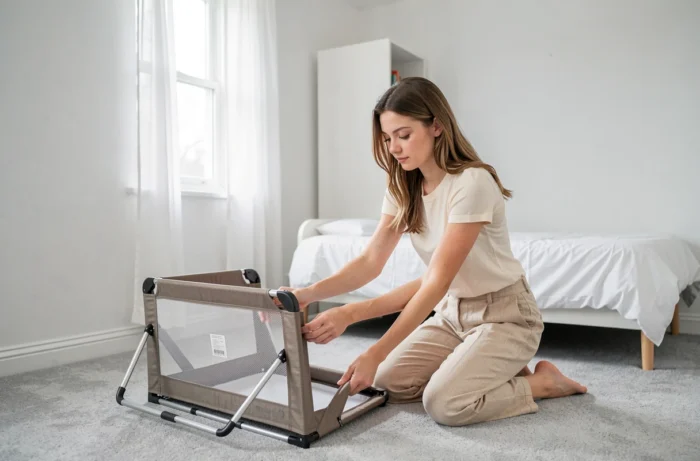
Folded Size and Actual Weight: Thresholds that Change Usage
All manufacturers claim compactness. In practice, two categories are clearly distinguished in the market.
The so-called “compact standard” models fold into a rectangular suitcase format. Their weight hovers around the high average of the segment, and their folded bulk remains acceptable for a standard-depth closet. Ultra-compact models, designed for air travel or storage in a narrow piece of furniture, drop significantly in weight and adopt a more elongated folding format, sometimes comparable to a sports bag.
- Folding format: a lengthwise fold (like a bag) fits in a hallway or behind a door, while a square block fold requires deeper storage space.
- Actual weight with cover and mattress included: the product sheet often indicates the weight without the cover or additional mattress. Adding these elements can significantly change the load to handle.
- Unfolded dimensions: a compact bed does not mean a reduced sleeping area. Some models maintain a standard sleeping surface while optimizing the height of the walls and the thickness of the posts.
We observe that the “intensive travel / airplane” segmentation is recent. Classic guides remain focused on car vacation usage and underestimate the constraints of weight and cabin or hold baggage formats.
Integrated Mattress and Sleeping Quality for Occasional Use
The mattress supplied with a compact travel crib is almost always a rigid sleeping base, not a real mattress. Its primary function is structural: it maintains the tension of the bed’s floor. Sleeping directly on it for several consecutive nights does not provide sufficient physiological support for an infant.
Adding a supplementary mattress seems logical, but this practice poses a compliance issue. The mattress must exactly fit the internal dimensions of the bed, without leaving a lateral space greater than the 30 mm prescribed by the standard. A mattress that is too small creates dangerous gaps. A mattress that is too thick raises the sleeping surface and reduces the effective height of the walls, compromising the anti-fall function.
For occasional use in a small space, a thin supplementary mattress, specifically designed for the chosen bed model, remains the only reliable option. Universal mattresses sold separately often present dimensional discrepancies with compact beds, whose internal measurements vary from one manufacturer to another.
Breathability of Walls in Poorly Ventilated Rooms
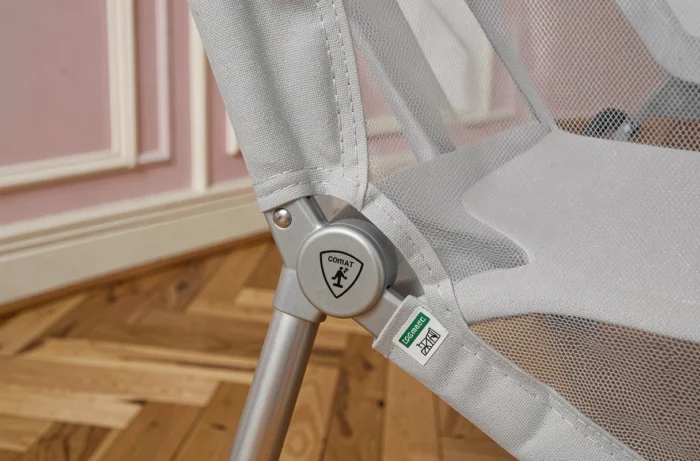
A studio or room without an openable window increases the need for air circulation around the sleeping area. Mesh walls ensure passive ventilation on all four sides. Models with solid textile panels on two sides reduce this airflow by half. In a confined space, walls entirely made of breathable mesh are preferable to a mixed model, even if the aesthetics suffer.
Folding Mechanism and Long-Term Reliability
The folding mechanism concentrates most negative feedback on compact beds. Two systems coexist.
Central folding (the bed folds in on itself from the middle) is the most common. It puts significant stress on the central joints, which are also the points of mechanical weakness. After several dozen folding-unfolding cycles, play may appear in these joints, affecting the overall stability of the bed.
Folding by retracting the legs (each leg folds individually inward) distributes mechanical stresses better. This system is more common on recent models designed for intensive travel. It produces a more compact folded format but requires a slightly longer setup action.
Checking for safety locks on each joint point is a reflex to adopt. An audible automatic locking (click) upon opening confirms that the structure is in a stable position. Models without audible or visual feedback require manual inspection of each joint, increasing the risk of assembly errors under fatigue conditions.
Frequency of Use and Choice of Mechanism
For a bed set up semi-permanently at grandparents’ or in a studio, the number of folding cycles remains low. The robustness of the mechanism matters less than stability in the open position. However, for frequent nomadic use, the durability of the joints becomes the discriminating criterion.
The last point to decide is the ease of assembly. A parent alone, in a restricted space, must be able to unfold and lock the bed with one hand in under a minute. Testing this action in-store or watching video demonstrations before purchase can prevent many disappointments once delivered in a forty-centimeter-wide hallway.