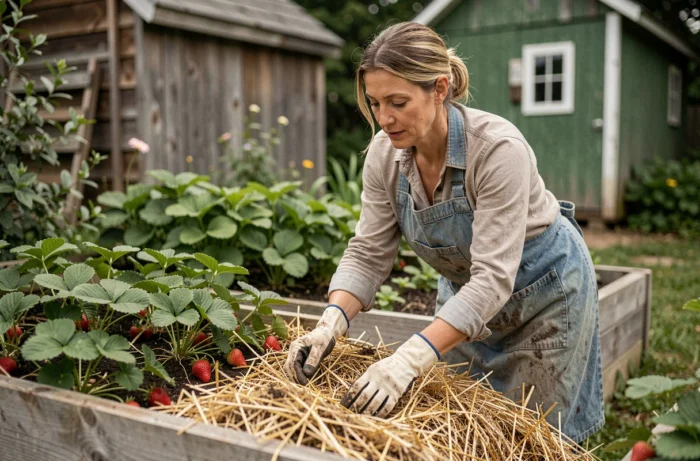
Strawberries consume a lot of water during fruiting, and this dependence worsens when the soil is left bare under direct sunlight. The top layer dries out within hours during peak summer heat. Natural mulching changes this dynamic by interposing a physical barrier between the soil and the atmosphere, which slows evaporation and keeps moisture at the root level longer after each watering.
Watering under the mulch: the technical gesture that changes the game
Most guides recommend mulching and then watering on top. This sequence poses a concrete problem: part of the water is absorbed by the mulch itself before reaching the soil, and another fraction evaporates upon contact with the hot surface of the mulch in the middle of summer.
A documented experience in August 2026 on a vegetable garden shows that by placing a microporous hose or drip emitters directly in contact with the soil and then covering them with organic mulch (straw, dry clippings, wood chips), the water remains trapped in the root zone and evaporates almost entirely into the hot air. The gardener in question reports that he no longer needs to take out the watering can every evening during heatwaves since he started watering under the mulch.
Applied to rows of strawberries, whose root system remains very shallow, this method makes perfect sense. You can find other tips from Jardiner Naturellement that detail the combination of mulching and low irrigation for strawberry crops.
A market gardener cited in an article from August 2026 applies this same logic of “reverse mulching” (buried water, mulch on top) and indicates a reduction in watering frequency of 50 to 70%, even during the most intense heatwaves. The topsoil then transforms into a protected moisture reserve.
Mulch thickness for strawberries: the threshold not to ignore
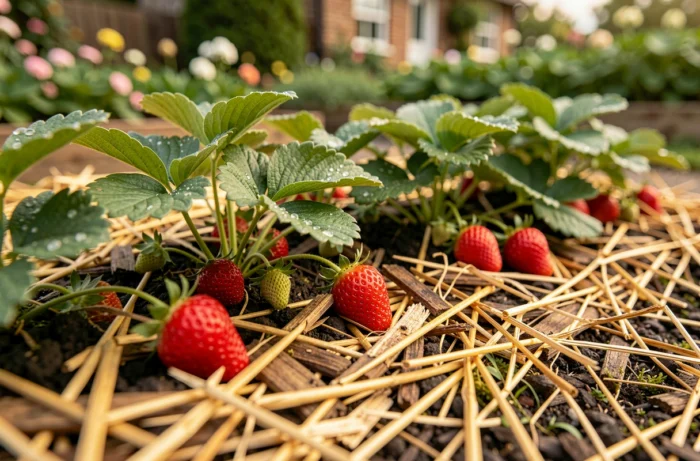
Applying a thin layer of straw around the plants is not enough to significantly reduce watering. The thickness of the mulch determines its ability to slow evaporation and block light that promotes weeds.
A technical article published in August 2026 recommends about 7 cm of mulch in the vegetable garden to achieve a real effect on moisture retention. Below this threshold, the sun penetrates the layer within hours, and the soil dries out almost as quickly as if it were bare.
For strawberries, this thickness must be adjusted carefully:
- The crown of the strawberry plant (the junction between stem and roots) should never be buried under the mulch, or it risks rotting. An area of a few centimeters should be cleared around each plant.
- Too compact a mulch (fresh grass clippings in a thick layer, for example) can ferment and heat up, damaging the shallow roots instead of protecting them.
- Light materials like wheat straw or shredded dry leaves allow air circulation while retaining moisture, which is better suited for strawberries than dense wood chips.
The goal is to reach this target thickness without suffocating the plants. A good indicator: by moving the mulch aside with your hand, the soil underneath should remain cool and slightly moist even after two or three days without watering in the middle of summer.
Which natural mulching materials are truly suitable for strawberries
Competitors often list about ten possible mulches without prioritizing them. In practice, not all materials are equal in reducing the watering of a row of strawberries, and some even create secondary problems.
Cereal straw and dry ferns
Straw remains the historical choice for strawberries, to the point that the word “strawberry” (strawberry in English) references it. It insulates the soil well, decomposes slowly, and does not acidify the earth. Dry ferns offer a similar profile with the added advantage of repelling certain gastropods due to their texture.
However, cereal straw can contain weed seeds if it has not been properly harvested. Its origin should be checked, and if possible, it should be left exposed to rain for a few weeks before use to allow unwanted seeds to germinate and be eliminated.
Dried grass clippings
Available for free in most gardens, grass clippings represent an economical mulch. They must be dried before application, otherwise they form a compact and slimy layer that ferments, heats up, and deprives the soil of oxygen.
Spread in a thin layer (3-4 cm), dried beforehand, and then supplemented with a second layer a week later to reach the target thickness, they work correctly. Field reports vary on this point: some gardeners report good water retention, while others find that the layer compacts too quickly and loses its effectiveness within weeks.
Wood chips and BRF
Wood chips (BRF) make an excellent long-term mulch. They decompose slowly, nourish soil life, and maintain consistent moisture. For strawberries, their main drawback is that they temporarily mobilize nitrogen during decomposition, which can slow plant growth if incorporated into the soil instead of remaining on the surface.
Applied on the surface without being mixed into the soil, BRF does not cause this nitrogen hunger and perfectly fulfills its role as a moisture regulator. It simply requires a sufficient thickness and should be renewed once a year.
Common mistakes that negate the effect of mulching on watering
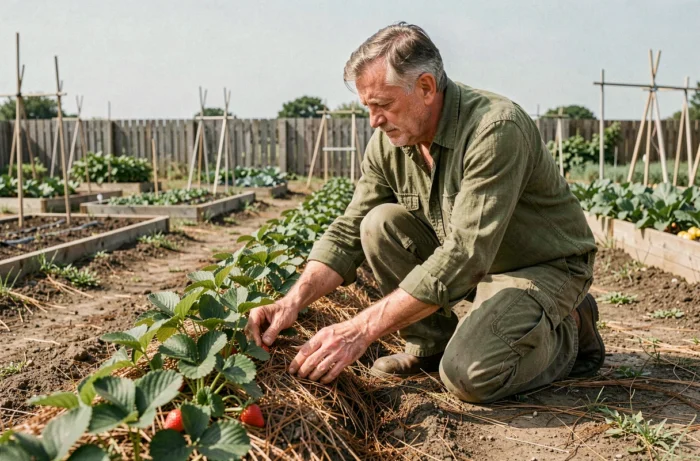
Mulching does not automatically guarantee a reduction in water consumption. Several common mistakes neutralize the expected benefits.
The first is mulching already dry soil. Mulching retains existing moisture but does not create it. Watering thoroughly before laying the mulch is a preliminary step that many gardeners overlook. Without this initial saturation, the mulch protects soil that has nothing to offer the roots.
The second mistake concerns the timing of installation. Applying mulch too early in spring, when the soil is still cold, prevents the earth from warming up. Strawberries then start more slowly. Waiting for the soil to reach a sufficient temperature (usually after the last frosts) before mulching allows the plants to establish properly.
The third mistake is never checking the condition of the mulch during the season. A mulch that has compacted, decomposed, or been displaced by the wind no longer serves its function. A check every three to four weeks with a supplement if necessary maintains the effectiveness of the system until the end of the harvest.
Natural mulching of strawberries is not a miracle solution, but a system that works when every parameter is respected: correct thickness, suitable material, pre-moistened soil, irrigation positioned under the mulch layer. If poorly executed, it can even exacerbate certain problems. When well implemented, it sustainably transforms water management at the base of strawberries.