
Doliprane and Aerius are among the most common medications found in French medicine cabinets. One relieves pain and fever, while the other alleviates allergic symptoms. When allergic rhinitis and headaches occur simultaneously, the temptation to combine both tablets is frequent. Available pharmacological data can clarify this question.
Hepatic metabolism of paracetamol and desloratadine: two distinct pathways
Competitors generally claim that there is no interaction between these two molecules. However, the details of the mechanism deserve attention, as they explain why the combination does not pose a direct pharmacological problem.
Paracetamol (the active ingredient in Doliprane) is primarily metabolized by the liver, through glucuronidation and sulfation reactions. A minor fraction goes through the cytochrome P450, generating a toxic metabolite (NAPQI), which is neutralized by hepatic glutathione as long as the doses remain within recommended limits.
Desloratadine (the active ingredient in Aerius) also follows a hepatic pathway, but it does not significantly engage the same enzymes as paracetamol. No notable enzymatic competition has been identified between these two substances. In practical terms, taking one does not slow down or speed up the elimination of the other.
It is this metabolic independence that underpins the current consensus: one can take Doliprane with Aerius at the same time without any known major pharmacological interaction.
Doliprane and hidden overdose: the real danger of this combination

The main risk does not come from desloratadine. It comes from paracetamol itself, and more specifically from its presence in many other medications taken simultaneously without the patient’s awareness.
The unintentional accumulation of paracetamol is the leading cause of drug-induced hepatic overdose. A cold treatment (such as Fervex, Actifed, Humex) often contains paracetamol. Adding Doliprane on top of that doubles the dose unknowingly.
The official leaflet for Doliprane 1000 mg sets the following guidelines for adults and adolescents weighing at least 50 kg:
- Single dose: one tablet of 1000 mg maximum, without taking two 1 g tablets simultaneously
- Interval between doses: at least 4 hours
- Usual maximum daily dose: 3 g per day, unless otherwise advised by a doctor
- Systematic checking of the composition of other ongoing medications to identify the presence of paracetamol
This ceiling of 3 g per day, mentioned in the recent leaflet, differs from the limit of 4 g still cited on some websites. This distinction is important for anyone managing multiple treatments concurrently.
Liver insufficiency and nutritional fragility: even lower thresholds
Individuals with hepatic or nutritional fragility should apply stricter dose limits. This precaution concerns paracetamol, but also desloratadine in certain cases.
For Doliprane, the leaflet indicates a maximum dose reduced to 2 g per day in cases of liver insufficiency, chronic alcoholism, or Gilbert’s syndrome. Individuals weighing less than 50 kg, malnourished, or dehydrated also require dosage adjustments.
On the Aerius side, desloratadine calls for specific caution in cases of severe renal insufficiency. Available data do not allow for precise conclusions about the necessary dose adjustment in this situation, which justifies prior medical advice.
The combination of both medications in a patient with both hepatic fragility and renal insufficiency represents a case where consulting a doctor or pharmacist becomes necessary, even if the two molecules remain theoretically compatible.
Warning signs after simultaneous intake of paracetamol and desloratadine
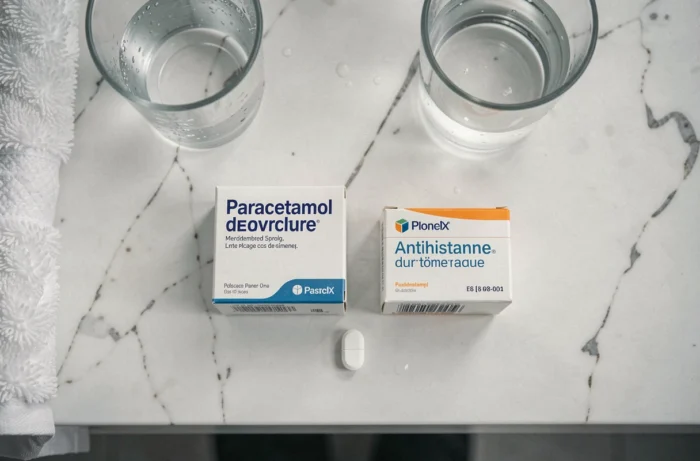
No serious interaction does not mean a total absence of vigilance. Certain signals should prompt the interruption of treatment and a quick consultation.
On the paracetamol side, signs of hepatic toxicity include:
- Persistent nausea or unusual vomiting within hours of taking
- Localized pain under the ribs on the right side (right upper quadrant), indicating liver distress
- Yellowing of the skin or the whites of the eyes (jaundice), a sign of advanced liver damage
On the desloratadine side, although Aerius is a second-generation antihistamine designed to limit drowsiness, marked fatigue or unusual palpitations after taking it warrant medical advice.
Alcohol consumption during paracetamol intake increases the hepatic risk. This precaution, often mentioned in leaflets, remains underestimated in practice.
Self-medication and over-the-counter drug combinations: the limits of individual reasoning
The fact that Doliprane and Aerius are both available without a prescription creates a false sense of security. Their accessibility in pharmacies does not exempt one from checking their compatibility with the entire ongoing treatment.
A pharmacist can check in a few minutes for the absence of paracetamol duplication in associated treatments. This simple reflex prevents the majority of accidental overdoses, which are much more frequent than interactions between distinct molecules.
Polypharmacy (taking multiple medications simultaneously) particularly concerns the elderly and patients treated for chronic diseases. In these situations, even a theoretically harmless combination deserves verification with a healthcare professional, if only to adjust the timing of doses.
The combination of paracetamol-desloratadine does not appear on any list of risky drug interactions. Paracetamol remains compatible with the vast majority of second-generation antihistamines. The danger lies in the accumulation of sources of paracetamol, not in the neighboring molecule. Checking the composition of each medication taken, adhering to the ceiling doses adapted to one’s profile, and consulting a pharmacist at the slightest doubt: these three actions are sufficient to secure simultaneous intake.