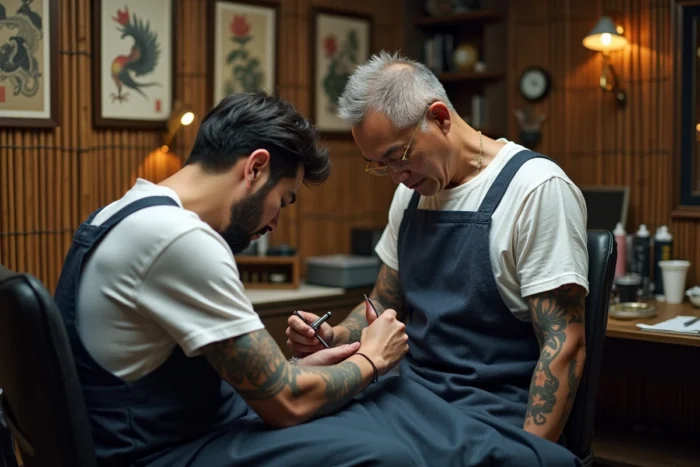
The Japanese phoenix tattoo does not represent a bird that rises from its ashes. In Japanese tradition, the creature called Hōō embodies cosmic harmony, virtue, and peace. This distinction from the Western phoenix influences the choice of design, its composition, and its interpretation by tattoo artists trained in irezumi.
Hōō vs. Western phoenix: a common confusion in tattooing
The majority of French-speaking articles present the Japanese phoenix as a simple Asian equivalent of the Greco-Roman phoenix. The Western narrative centers on individual death and resurrection: the bird burns and then rises from its ashes. The Japanese Hōō operates differently.
In Japanese mythology, the Hōō descends to Earth when harmony reigns among men. It retreats to the sky when conflicts arise. Its appearance is not linked to a personal trial but to a collective state of peace and prosperity. The values it carries (loyalty, justice, obedience) pertain to social bonds, not individual trajectories.
To explore the symbolic nuances specific to Japanese culture, one can visit the Oh my shoe website, which details these distinctions between Eastern and Western traditions.
This difference has a direct consequence on tattooing. A Hōō tattooed according to the rules of irezumi does not tell a story of personal rebirth. It asserts an ideal of balance, an aspiration to moral nobility. Confusing the two amounts to wearing a symbol whose meaning one does not fully grasp.
Imperial symbolism of the Hōō: a political motif before being decorative
Tattoo blogs focus on the personal dimension of the phoenix (resilience, transformation). They overlook a major layer of interpretation: the Hōō is historically linked to Japanese imperial power.
In Japanese arts, this creature appears on noble textiles, particularly ceremonial kimonos. It signals the beginning of a reign, the legitimacy of the sovereign, and favorable omens. Hōō motifs woven into the silk of aristocratic garments were not ornamental: they carried a political message of peace and prosperity under the emperor’s authority.
The Ryukyu Kingdom (present-day Okinawa) offers a regional variant. Under this dynasty, the phoenix served as a motif for the protection of the king and the kingdom. It can be found in bingata fabrics and lacquers, associated with the high priestess (Kikoe-ōgimi). This religious and protective dimension adds a layer of meaning absent from most contemporary tattoos.
Choosing a Hōō as a tattoo is therefore to carry a symbol that has served for centuries to legitimize power. This political weight does not disappear simply because it is ignored.
Composition of the phoenix in traditional irezumi: rules and associations
Irezumi adheres to strict composition conventions. The Hōō is not an isolated motif: it fits into a visual system where each element interacts with the others.
Classic associations of the Hōō
- Hōō and dragon: this pair forms the quintessential imperial duo. The dragon (ryū) represents masculine power and earthly forces, while the Hōō embodies grace and celestial harmony. Together, they symbolize the balance between yin and yang, a common motif in large back pieces.
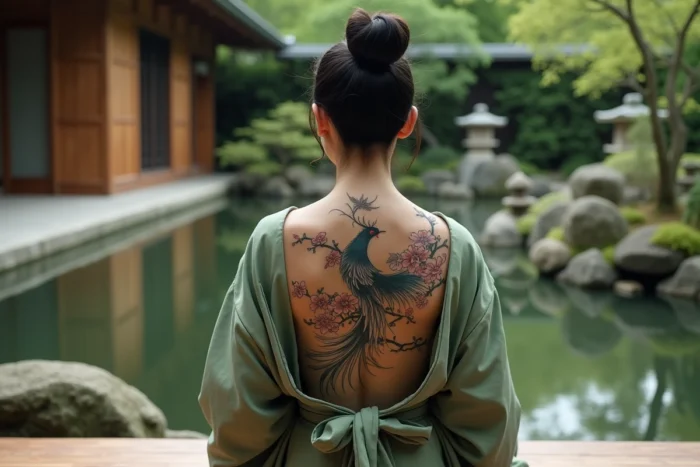
- Hōō and paulownia flowers (kiri): in traditional iconography, the Hōō exclusively perches on the paulownia tree. This association has been codified for centuries in Japanese heraldry (mon). Replacing the paulownia with cherry trees or peonies is an aesthetic choice that deviates from tradition.
- Hōō and chrysanthemum (kiku): the chrysanthemum, a symbol of perfection and light in Japanese culture, sometimes accompanies the Hōō to reinforce its imperial dimension. The two motifs share a connection with the imperial family.
- Hōō and clouds or flames: stylized cloud swirls (kumo) and flames serve as a backdrop for the Hōō. They enhance its celestial character and supernatural nature without adding contradictory symbolism.
Placement and format in irezumi tradition
The Hōō lends itself to large surfaces: full back (sōshinbori), long sleeves, sides. Its silhouette with long tail feathers requires space to showcase the characteristic curves of the Japanese style. A Hōō reduced to a small size loses part of its readability and visual impact.
Tattoo artists trained in irezumi use gradients (bokashi) to create depth around the bird. The background is never empty: waves, clouds, or geometric patterns fill the space according to flow rules that guide the eye along the body.
Color palette of the Hōō: what colors mean in irezumi
In the art of traditional Japanese tattooing, colors are not decorative. Each shade carries a codified meaning.
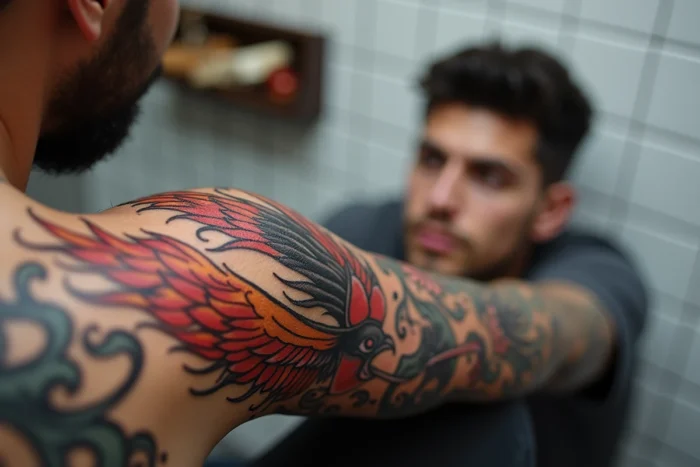
The Hōō most often appears in shades of red, gold, and orange, which refer to fire, solar power, and nobility. The red of the Hōō signals the vitality and sacred nature of the motif. Some tattoo artists add blue or green to the feathers to create contrast with the surrounding flames.
An entirely black Hōō (sumi) remains a consistent option with tradition. Ukiyo-e prints show phoenixes treated solely in black ink, where the play of shadows replaces color. This choice highlights the tattoo artist’s technique rather than the chromatic effect.
The chosen palette alters the interpretation of the motif. A flamboyant Hōō in red and gold emphasizes the imperial and solar dimension. A Hōō in black and gray leans towards a more subdued interpretation, focused on form and movement. No option is more “authentic” than another, but the choice of colors must be deliberate, not arbitrary.
The Hōō remains one of the most demanding motifs in irezumi, both for the tattoo artist and the person being tattooed. Its symbolic richness far exceeds the idea of rebirth that the general public attributes to it. Understanding the difference between the Western phoenix and the Japanese Hōō, knowing its ties to imperial power, and respecting composition conventions are three prerequisites before embarking on a tattoo project of this magnitude.