
The Peugeot Boxer refuses to start, the immobilizer light remains steadily lit on the dashboard, and the starter doesn’t budge. The vehicle has been parked for a week on a construction site or in a depot, and the battery was disconnected for maintenance.
When it’s time to leave, the immobilization system blocks everything. On this utility vehicle, the anti-theft system is managed by the BSI (Intelligent Service Box), not by a simple fuse that could be removed. Understanding this architecture changes the entire approach to deactivation.
BSI and engine control unit of the Boxer: the duo that locks the start
On recent generations of the Peugeot Boxer, the anti-theft system relies on coded communication between the BSI and the engine control unit (ECU). When the key is inserted, the transponder embedded in the key head sends a code to the BSI, which compares it to its memory. If the code matches, the BSI allows the engine control unit to release the injection.
The BSM (Engine Service Box), often confused with the BSI, is just a power distributor. Removing a fuse from the BSM cuts power to a circuit, but does not neutralize the anti-theft function coded in the BSI. You can still find advice on forums pointing to a “miracle fuse”: on a modern Boxer, this leads to a dead end.
When looking to understand how to disable the anti-theft system on a Peugeot Boxer, the distinction between mechanical intervention and software intervention is the first sorting to be done. Most persistent blockages require going through the onboard electronics.
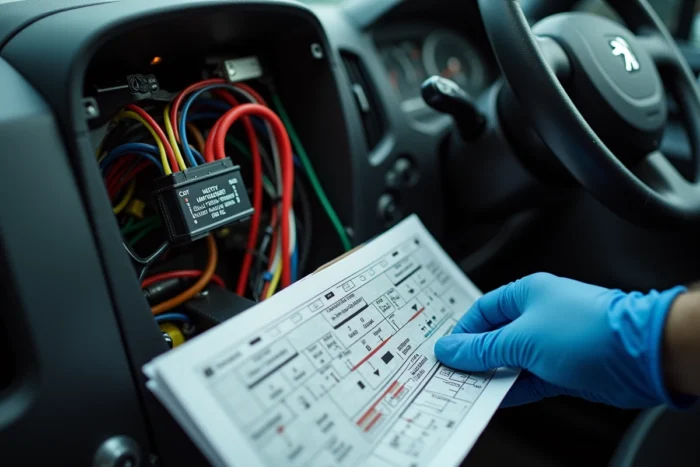
Disabling the anti-theft system of the Peugeot Boxer: three concrete scenarios
Not all blockages are the same. The method depends on the origin of the problem. Here are the three most common situations on the ground.
Loss of synchronization after battery disconnection
This is the classic case on a fleet utility vehicle. The battery has been disconnected for several hours (replacement, winter storage, intervention on the electrical circuit). Upon reconnection, the BSI no longer recognizes the key immediately.
The basic procedure: turn on the ignition with the original key, wait for the immobilizer light to blink and then turn off, cut the ignition and repeat. On some versions of the Boxer, this sequence must be repeated three times for the BSI to relearn the transponder code. Feedback on this point varies depending on the vehicle generation and the BSI software version.
Unrecognized key or faulty transponder
The transponder housed in the key can fail without warning. The key turns in the ignition, the dashboard lights up, but the immobilizer light remains steady and the starter does not engage.
Testing with the spare key is the first reflex to have. If the second key works, the problem is localized to the transponder of the first. If neither key works, the issue comes from the BSI, the reception antenna around the ignition, or the engine control unit.
Faulty or corroded BSI
The BSI of the Boxer is installed under the dashboard on the driver’s side. On utility vehicles exposed to moisture (refrigerated vans, construction vehicles), the BSI connectors can oxidize. A corroded BSI sends erratic information to the engine control unit, which randomly triggers the anti-theft system.
In this case, cleaning the connectors with an electronic contact cleaner may suffice temporarily. If the problem recurs, the BSI must be repaired or replaced, then reprogrammed with a compatible diagnostic tool (such as Diagbox for PSA vehicles).
Software removal of the anti-theft system on Bosch EDC15C7 control unit
Some Boxers equipped with 2.2 HDi or 2.8 HDi engines use a Bosch EDC15C7 control unit. For these engines, there is a service to remove the anti-theft system by reprogramming the control unit. The original file is modified so that the engine control unit no longer waits for BSI validation before allowing injection.
This intervention is offered by specialized automotive electronics providers. It concerns specific cases:
- BSI out of service with no replacement part available (old vehicle, part unavailable)
- Conversion of a vehicle for a specific use (construction machinery, mobile generator) where the anti-theft function no longer makes sense
- Replacement of the engine control unit with a model not coded to the original BSI
The software removal makes the vehicle non-compliant with its original homologation. On the road, this poses an insurance problem in case of theft. On a vehicle that no longer circulates on public roads, the question does not arise in the same way.

Peugeot Boxer anti-theft diagnosis: checks before any intervention
Before discussing deactivation or reprogramming, a methodical diagnosis avoids unnecessarily replacing parts. Here is the logical sequence:
- Check the battery condition (voltage above the minimum threshold, clean and tight terminals). An underpowered BSI behaves inconsistently
- Test both keys of the vehicle to isolate a transponder problem
- Visually inspect the BSI connectors under the dashboard (green oxidation traces, bent pins)
- Read the fault codes with a compatible PSA OBD diagnostic tool. The fault code specifies whether the blockage comes from the transponder, the antenna, or the BSI-ECU communication
Without a diagnostic tool, one proceeds blindly. Low-end generic tools do not always read the specific codes for the PSA anti-theft system. A Diagbox-compatible tool or a professional equivalent provides access to the BSI data.
When to call an automotive electronics specialist
If the immobilizer light remains steady after basic checks, if no key works, or if the fault code points to an internal failure of the BSI, the intervention of an automotive electronics specialist becomes the only realistic option. Attempting to bridge the system without understanding the architecture risks permanently locking the BSI.
The Peugeot Boxer shares its platform with the Citroën Jumper and the Fiat Ducato. Feedback from experience on these three models is often transferable, which broadens the resources available to find a solution suited to one’s specific case.