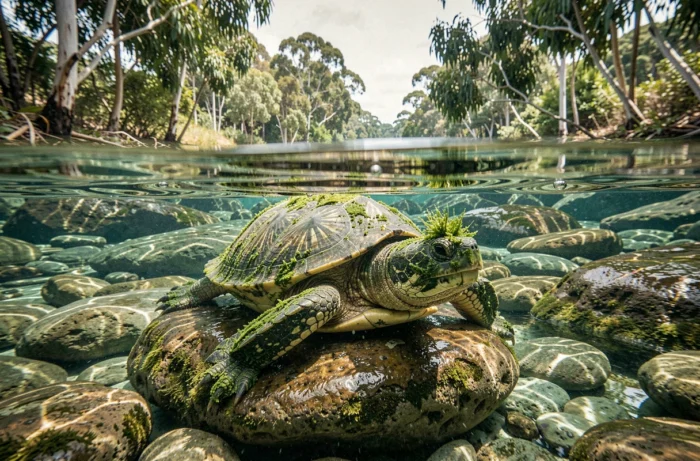
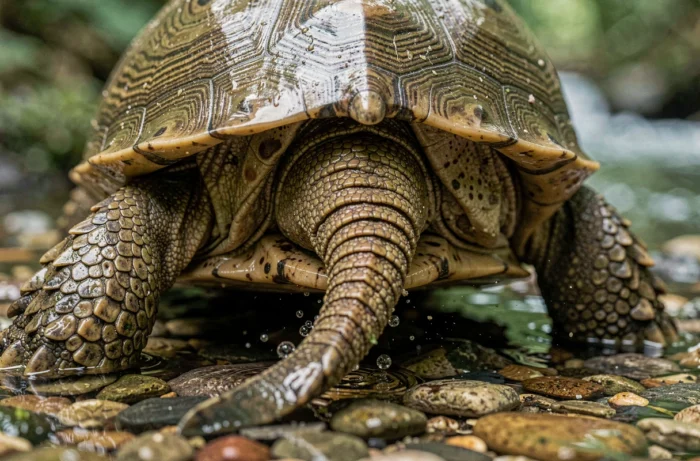
The Mary River turtle (Elusor macrurus) absorbs a significant portion of its oxygen through the cloaca, a unique opening located at the base of its tail. This mechanism, called cloacal respiration, allows it to remain submerged much longer than most other freshwater turtles. To understand what makes this adaptation so special, one must examine the physiological and environmental constraints that shape it.
Cloacal respiration and pulmonary respiration: two pathways compared
The Mary River turtle has not given up its lungs. It occasionally surfaces to breathe air, like any turtle. However, its ability to extract dissolved oxygen from the water through the richly vascularized tissues of its cloaca is a rare complement among reptiles.
| Respiratory mode | Involved organ | Medium | Possible immersion duration |
|---|---|---|---|
| Pulmonary (all turtles) | Lungs | Atmospheric air | Variable, requires regular surfacing |
| Cloacal (Elusor macrurus) | Vascularized cloacal sacs | Oxygenated freshwater | Extended, up to several days under favorable conditions |
This dual respiratory capacity gives Elusor macrurus a distinct advantage in the well-oxygenated waterways of southeastern Queensland, Australia. The animal reduces its surfacing, which limits its exposure to predators.
To delve deeper into the respiration of the Mary River turtle, it is important to note that this adaptation is not shared by marine turtles or terrestrial turtles. Only certain freshwater turtles possess sufficiently developed cloacal sacs to ensure significant gas exchange.
Oxygenation of water and temperature: the physiological limits of cloacal respiration
Cloacal respiration does not function under just any conditions. Respiratory performance declines outside an appropriate thermal range, as confirmed by a study published in September 2026 in Frontiers in Marine Science on a tropical aquatic turtle. This principle directly applies to Elusor macrurus.
Two factors condition the effectiveness of this mechanism:
- The dissolved oxygen level in the water: in a fast-flowing and well-mixed stream, cloacal extraction is maximized. In stagnant or polluted water, the turtle must surface to breathe much more frequently.
- The water temperature: water that is too warm contains less dissolved oxygen and accelerates the animal’s metabolism, increasing its needs while reducing the available resource.
- The hydrological flow: dams and water withdrawals alter the current speed, and thus the renewal of oxygen in the areas where the turtle lives.
Cloacal respiration is not an autonomous mechanism that would replace the lungs. It functions as a supplement whose effectiveness is closely dependent on the aquatic environment. This point is often underestimated when presenting this turtle as an animal capable of “breathing underwater.”
Hydrological regulation of the Mary River and species decline
Elusor macrurus is listed as a threatened species. Recent analyses shift the focus: the hydrological management of rivers weighs as heavily as predation on the decline of this turtle. A publication from September 2026 in Aquatic Conservation: Marine and Freshwater Ecosystems links the decline of large threatened river turtles to flow regulation.
The Mary River in Queensland is subject to water withdrawals for agriculture and urban supply. When the flow decreases, the rapid areas where Elusor macrurus feeds and breathes through the cloaca lose oxygenation. The animal finds itself forced to surface more often, which exposes it more to terrestrial predators and boats.
Monitoring through environmental DNA
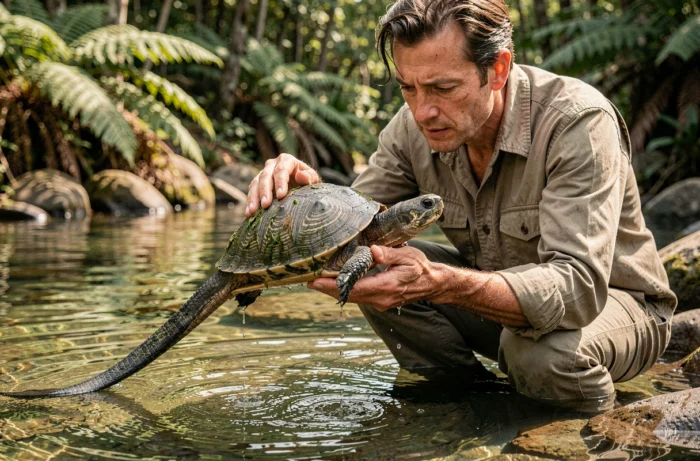
Environmental DNA (eDNA) monitoring programs are underway in the Mary River basin. The principle is to detect the presence of the species by analyzing water samples, without capturing or disturbing the individuals. eDNA allows for mapping the actual distribution of the turtle in difficult-to-access river sections.
This data informs hydraulic management decisions: maintaining a minimum flow in certain segments to preserve the respiratory habitat of the species.
Algae on the shell: an indicator of time spent underwater
The Mary River turtle is often photographed with a crest of green algae on its head and shell, earning it the nickname “punk turtle.” These algae grow because the animal remains submerged long enough for vegetation to colonize its shell.
This visual detail is an indirect marker of the effectiveness of cloacal respiration. A turtle that frequently surfaces partially dries out, which prevents algal growth. In contrast, prolonged and continuous immersion promotes the establishment of a biofilm and then filamentous algae.
The algae do not hinder the turtle. They even provide partial camouflage in the shallow, vegetation-rich waters. The punk appearance is a direct consequence of respiration that reduces surfacing.
Why the Mary River turtle remains an extreme case among reptiles
Other freshwater turtles practice a form of cloacal respiration, but none seem to use it as intensively as Elusor macrurus. The combination of a highly vascularized cloaca, a relatively low metabolism, and a naturally well-oxygenated habitat creates conditions that few species meet.
The main risk for this turtle does not come from a flaw in its respiratory system, but from the progressive degradation of the environment that makes it possible. Altering the flow of a river amounts to reducing the animal’s respiratory capacity, even if its lungs and cloaca function normally. Therefore, the conservation of this species relies less on the individual protection of turtles than on maintaining the hydrological conditions of the Mary River.