
The ANCV holiday vouchers are still accepted by the vast majority of hotels affiliated with the network, but the actual payment conditions vary greatly from one establishment to another. Understanding the nuances of the Connect format, the limitations of paper vouchers, and the increasing refusals from certain hosts can help avoid unpleasant surprises at check-out.
Refusal of holiday vouchers in hotels: a structural phenomenon to anticipate
We have observed an increase in refusals of holiday vouchers in certain accommodations, including hotels, over several seasons. The reasons are primarily administrative: commissions deducted by ANCV, reimbursement delays for the hotelier, and manual management of paper vouchers.
Some independent establishments or hotel residences now explicitly communicate that they no longer accept holiday vouchers. Before making any reservation, we recommend checking acceptance directly with the hotel, without relying solely on the online directory of the ANCV guide.
In practice, a hotel may be listed in the ANCV directory but have suspended the acceptance of paper vouchers while still accepting the Connect format, or vice versa. The mention “holiday vouchers accepted” on a third-party booking site (such as Booking) guarantees nothing: only the hotel confirms the terms at the time of booking.
To pay for a hotel with holiday vouchers without issues, the best practice is to contact the reception before arriving, specifying the format (Classic or Connect) and the approximate amount.
Connect Holiday Voucher and hotel payment: technical procedure

The dematerialized Connect format works exclusively through the Chèque-Vacances mobile application. All payments go through this application, validated by a 6-digit payment code or by biometrics if the option is activated.
In hotels, two scenarios arise:
- On-site payment: the hotelier generates a payment request, and the client validates it from their application. The amount is debited to the nearest cent, avoiding the change issues associated with paper vouchers.
- Remote payment: some hotels and travel agencies accept Connect payment before arrival, at the time of booking confirmation. The client receives a notification in the app and validates the payment.
- Payment via an intermediary agency: physical and online networks accept ANCV holiday vouchers (both paper and Connect) for packaged stays including hotel accommodation, sometimes with the option of installment payments through a credit partner.
Connect payment is only possible with members of the Chèque-Vacances Connect network, which can be consulted at leguide.ancv.com. A hotel that accepts paper vouchers does not necessarily accept Connect.
Mixed basket: complementing holiday vouchers with a credit card
The price of a night often exceeds the available balance in holiday vouchers. Complementing with a credit card or bank transfer is possible in most cases, provided that the hotelier or agency allows it in their sales conditions.
This mixed basket practice is becoming more common. Some travel operators specify in their 2026 conditions that partial payment with holiday vouchers, supplemented by another payment method, is explicitly accepted. We recommend clarifying this point at the time of booking, as not all cash register systems natively manage splitting.
The Connect format facilitates this mixing: the exact desired amount is entered in the app, and the balance is settled by card. With paper vouchers, the situation is less flexible. The denominations have fixed values, and the hotelier is not required to give change on a holiday voucher. It’s better to adjust the number of vouchers as closely as possible to the amount due.
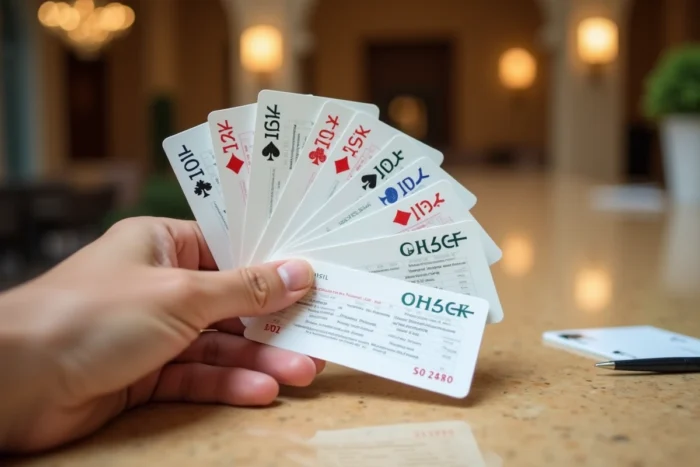
Paper ANCV holiday vouchers: specific constraints in hospitality
The Classic format (paper) is still in circulation, but its use in hotels poses constraints that the Connect format has largely resolved.
- The denominations exist in several values. A payment often requires combining several vouchers, with a risk of exceeding the exact amount of the bill.
- Paper holiday vouchers have an expiration date. Expired vouchers can be exchanged at ANCV, but a hotelier will systematically refuse them.
- Postal sending of paper vouchers for a remote reservation is still practiced by some agencies, but the delays prolong confirmation. Prefer Connect for any online booking.
For employees who still receive paper vouchers through their CSE or employer, the migration to the Connect format is done via the application, provided that the company offers this format.
Online booking and holiday vouchers: what really works
Major booking platforms (Booking, Expedia) do not directly manage payments in holiday vouchers. The reservation is made on the platform, but the payment in holiday vouchers is made at the hotel, during the stay.
For this to work, it is necessary to select the “pay at the hotel” option (and not the online prepayment by card). Not all hotels offer this option on OTAs. Filtering results by payment method allows identifying compatible establishments.
Some online travel agencies, on the other hand, accept direct payment in holiday vouchers, including for packages that include the hotel. This option remains more reliable for full payment in ANCV vouchers, as the agency centralizes the administrative processing.
The choice between booking through a platform or through an agency accepting holiday vouchers depends on the amount covered by the vouchers. For a stay where nearly the entire price is covered, the agency simplifies the transaction. For a marginal complement, direct booking with payment on-site remains the most practical solution.