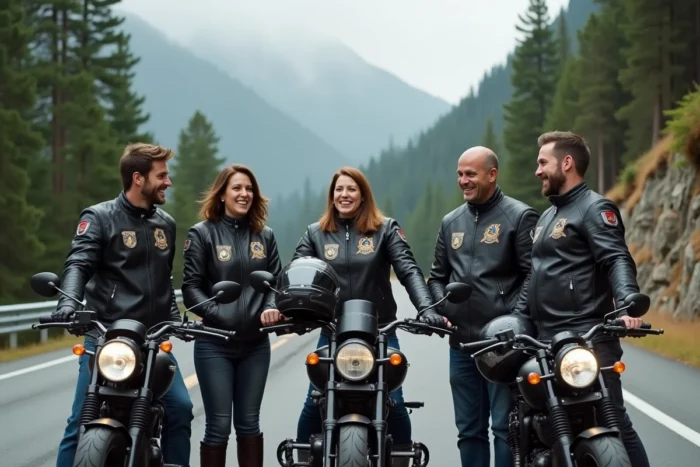
A motorcycle club is not just about a calendar of Sunday rides. The associative structure determines the quality of outings, the management of mechanical risks, and the ability to absorb the continuous rise in costs associated with the activity. Joining a structured club changes the game regarding aspects that solo riders rarely manage optimally.
Cost sharing for motorcycles: the lever that forums underestimate
The surge in fuel prices has made trips to circuits and gathering places significantly more expensive. The journeys to participate in a competition or a track day often weigh more heavily than the consumption on the circuit itself.
An organized club allows for sharing trailers, transport vehicles, and travel expenses. Three riders sharing a van to a circuit divide the fuel budget by three, making a frequency of outings otherwise unmanageable viable.
Beyond transportation, sharing also applies to specialized tools (workshop stands, diagnostic tools, tire equipment). Investing alone in this equipment is rarely justified for occasional use. In a club, the amortization becomes collective and the availability immediate. We observe that structures organizing shared mechanical workshops retain their members better, precisely because the return on membership fees is tangible.
It is on this ground that Motor X Club builds its proposition: regular outings with logistics designed to reduce the unit cost of each riding day.
Collective feedback on Chinese motorcycles and new models
The French motorcycle market is undergoing rapid transformation. In May 2026, one in six new motorcycles sold in France was Chinese, with brands like CFMOTO and Zontes gaining significant market share. This evolution raises concrete questions: medium-term reliability, availability of parts, actual behavior on the road and track.
A structured club becomes a laboratory for real-world feedback. When several members ride recent models from emerging brands, data accumulates quickly: wear of consumables, responsiveness of the after-sales service network, compatibility of accessories. This type of information is not found in a press test conducted over 200 kilometers.
We recommend that riders considering the purchase of a machine from a less established brand cross-reference feedback from several users in real conditions. The club setting facilitates these exchanges without commercial filters.
Comparative tests in real conditions
Some clubs organize test days where members can try each other’s bikes. Riding another member’s machine during an outing allows for comparison of dynamic behavior, ergonomics, and comfort on the same route. This format does not exist in any dealership network.
Motorcycle road safety: what a club offers beyond the license
Motorcycle license training covers the fundamentals, but it does not prepare riders for situations encountered after several thousand kilometers: emergency braking on wet roads while loaded, cornering trajectory with a passenger, managing a group on open roads.
- Guided outings require a safety briefing that includes reminders of safe distances, positions in the group, and hand signals between riders.
- An experienced tail rider at the back of the convoy detects dropouts and risky behaviors before they escalate.
- Training days on closed circuits allow for practicing hard braking and evasive maneuvers without the danger of traffic.
Prevention initiatives involving police and motorcyclists are multiplying. The gendarmerie of Loire organized a sharing experience day for motorcyclists in May 2026, proving that institutions recognize the role of collectives in reducing accidents.
The Motor X Club incorporates this dimension into its outings, with supervision that goes beyond simple GPS guidance.
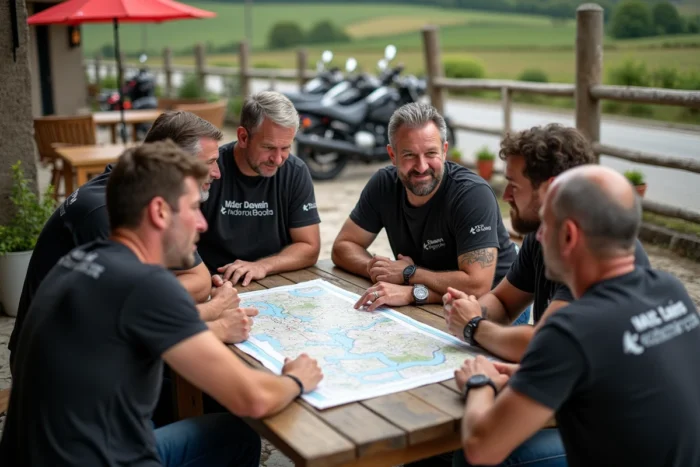
Life in a motorcycle club: associative structure and real commitment
A motorcycle club operates as a 1901 law association with its obligations: general assembly, accounts, civil liabilities. This legal framework protects members in case of an incident during an organized outing, provided that the club’s insurance explicitly covers declared activities.
Checking the club’s civil liability insurance coverage before joining is a reflex that few riders have. The annual membership fee should cover, at a minimum, the organizer’s liability and repatriation assistance during long-distance outings.
What differentiates an active club from a showcase club
We observe three reliable markers:
- The actual frequency of outings over the past twelve months (not the announced calendar, but what was actually carried out).
- The presence of mechanical workshops or supervised training sessions, which reflect an investment beyond simple rides.
- Financial transparency: a club that publishes its accounts and details the use of membership fees inspires justified trust.
A club like Motor X Club that communicates about its past as well as future activities allows prospective members to assess the reality of commitment before signing.
The choice of a motorcycle club is made based on measurable criteria: actual cost per outing, insurance coverage, activity frequency, and diversity of formats offered. The passion for motorcycles is better experienced when logistics and safety are collectively managed, and this is precisely what well-managed structures offer their members.