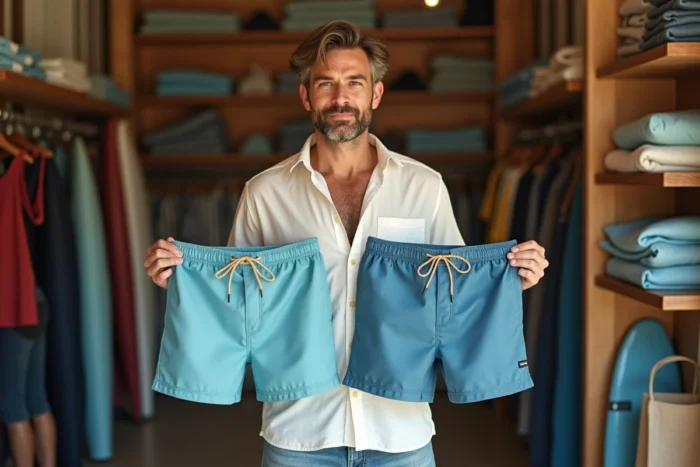
A swim short is distinguished from a classic short by its textile design: quick-drying synthetic fabric, inner mesh lining, and reinforced seams against salt and chlorine. These three technical characteristics separate a garment designed for water from a simple short worn at the beach for convenience.
Mesh lining and integrated brief: the first reflex in the fitting room
The most reliable criterion for identifying a swim short remains the inner mesh or net lining. This layer, sewn at the crotch, replaces underwear and allows water to drain without stagnating against the skin. A city short, even if lightweight, does not have this.
In-store, turn the short inside out and check the interior. The mesh is usually made of perforated polyester, sometimes replaced by a more covering integrated brief on swim-oriented models. If the interior only has a flat seam without any lining, the garment was not designed for swimming.
Some hybrid shorts, marketed as “swim and city,” intentionally omit this lining for everyday comfort. They dry quickly, but without an inner mesh, support in the water remains limited. To clarify the differences between these categories, you can visit the CC Rhin website, which details the specific characteristics of each type of short.

Textile composition on the label: polyester, polyamide, or blend
The composition label provides direct information about the garment’s intended use. A swim short almost always displays a majority of polyester or polyamide, two synthetic fibers that resist salt water, chlorine, and UV better than cotton.
Polyester dominates the market for mainstream swim shorts. It dries quickly, retains its colors for a long time, and withstands repeated washes after swimming. Polyamide (often labeled “nylon”) offers a softer feel and better elasticity, making it common on fitted or technical models.
- A short made of 100% polyester or polyamide is almost always a swim short, especially if it includes elastane for stretch.
- A cotton-polyester blend (60/40 or 50/50) indicates a hybrid short, suitable for the beach but not optimized for swimming.
- A short made of 100% cotton, linen, or viscose is a city garment. It absorbs water, takes hours to dry, and distorts with prolonged contact with water.
When the label mentions a water-repellent or anti-UV treatment, it is an additional clue. These treatments only make sense on a garment intended to get wet and be exposed to the sun.
Finishes and design details visible in-store
Beyond the fabric, several manufacturing details reveal a short’s beachwear purpose. Water drainage eyelets, small metal holes placed on the back or side pockets, are among the most obvious. They allow trapped water in the pockets to drain after swimming.
The waistband also deserves examination. A swim short uses an elastic drawstring, sometimes reinforced with Velcro, rather than a button fly or a rigid closure system. This technical choice prevents the mechanism from rusting or causing injury while swimming.
Specific seams and reinforcements
The seams of a swim short are often heat-sealed or top-stitched with synthetic thread resistant to salt. On a city short, cotton thread seams are sufficient because the garment is not subjected to the abrasion of sand or the corrosive action of chlorinated water.
The pockets of a swim short are made of mesh or are absent. On a city model, they are lined with cotton or polycotton, which retains water. A simple test: if the inner pocket lets light through when you stretch it, it is mesh, and the short is designed for water.

Environmental labeling and textile regulations to watch
Textile environmental labeling will come into effect in France starting October 2025, with a ramp-up expected by October 2026. This system requires manufacturers to communicate an environmental score on their products, which will gradually facilitate comparisons between swim shorts.
Another evolution to be aware of: the digital product passport will arrive in textiles starting in 2027, as part of the European ESPR regulation. A QR code on the label will provide access to the exact composition, ecological impact, and manufacturing conditions. For a buyer, this will be a direct way to verify whether a short is truly technical or simply dressed as a swim short.
The French anti-fast fashion law, definitively adopted in July 2026, also increases pressure on textile brands. Products with a high environmental impact will need to include penalties or specific mentions, which could change how some low-end shorts are labeled and marketed.
Summary of checks to make in-store
- Turn the short inside out to look for the mesh lining or integrated brief.
- Read the composition label: majority polyester or polyamide, with or without elastane.
- Inspect the pockets (mesh or solid fabric) and look for water drainage eyelets.
- Check the type of closure: elastic drawstring rather than button fly.
- Observe the seams: synthetic thread, reinforced top-stitching, or heat-sealing.
These five points take less than a minute to check and allow you to distinguish a true swim short from a city short sold in the summer section. With the upcoming introduction of the digital product passport, this verification will become even simpler: a scan will be enough to access all the technical characteristics of the garment.