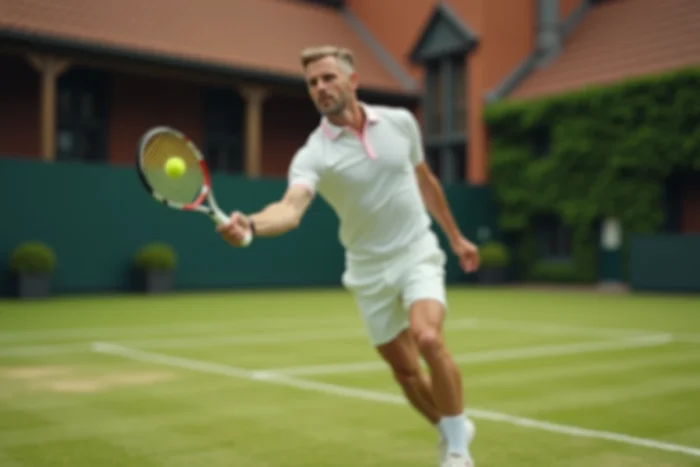
During the first fortnight of Wimbledon 2026, commentators made numerous references to Stefan Edberg to describe the net approaches of several young players. This phenomenon goes beyond mere nostalgic anecdotes. Behind these comparisons, regulatory, tactical, and cultural evolutions converge to bring back an attacking style of tennis that the Swede elevated to its peak between the late 1980s and the mid-1990s.
Serve-and-volley and Project 28: what ATP reforms change for attacking play
The ATP is working on a restructuring plan called “Project 28”. Among the measures discussed is a significant reduction in doubles draws at the Masters 1000, ATP 500, and ATP 250 tournaments. Revenue distribution would shift to 90% for singles and 10% for doubles.
Édouard Roger-Vasselin summarized the concerns of many experts: doubles could, in his view, “completely disappear” in the long term. This prospect pushes singles players to integrate doubles-derived patterns into their own game, specifically systematic net approaches, volley coverage, and serve-and-volley sequences that Stefan Edberg mastered better than anyone.
This tactical lineage is concretely manifested in the new generation. An article dedicated to Stefan Edberg’s style in 2026 details the mechanisms of this resurgence. The link between the gradual disappearance of doubles and the reappropriation of net play in singles is not trivial: it reshapes the very training of players.
Wimbledon 2026 and video review: how fast surfaces favor the return of the net
Wimbledon introduced video review on grass for the first time in 2026. This change, seemingly innocuous, alters the dynamics of rallies. Players who approach the net now benefit from a clearer framework to challenge calls on balls close to the lines, where the grass made bounces difficult to judge with the naked eye.
Grass remains the surface that most rewards attacking play. Low and fast bounces make passing shots riskier and volleys more effective. Edberg built his successes at Wimbledon thanks to this reading of the game on grass.
The net is becoming a zone of conclusion again, not a tactical accident.
Aesthetics of tennis and nostalgia: why Edberg embodies “quiet luxury” in sports
The return of Edberg’s style is not limited to tactics. It also touches on image. The trend of “quiet luxury,” dominant in fashion for several seasons, finds a direct echo in the world of tennis. Edberg embodied an elegance without ostentation, a readable game, measured behavior on the court, and a clean style of dress under Adidas colors.
Equipment brands are tapping into this vein. The tennis collections for summer 2026 feature numerous retro cuts and understated colors inspired by outfits from the 1980s-1990s. Several players on the circuit wear models that openly reference the Scandinavian aesthetic of that period.
This phenomenon relies on two distinct vectors:
- Coaching, as Edberg himself influenced a generation of coaches when he mentored Roger Federer, directly passing on his principles of offensive play.
- Specialized media, which use Edberg as a systematic reference whenever a player adopts a serve-and-volley profile, maintaining the loop of notoriety.
Super tie-break and short formats: a structural advantage for attackers
Since the gradual harmonization of the super tie-break to 10 points in the fifth sets of Grand Slam tournaments, marathon matches have become rarer. This shorter format favors players who can finish quickly, impose their rhythm, and take calculated risks at the net.
Edberg excelled in moments of brief tension. His ability to serve and volley under pressure, to convert break points through a serve-and-volley sequence, already aligned with a logic of point efficiency. The super tie-break exactly replicates this demand for clutch play.
Baseline players who relied on wearing down their opponents in decisive sets lose a lever. In contrast, aggressive profiles have a framework where each point carries more weight, which values risk-taking and finishing at the net. The format acts as a natural filter in favor of the style Edberg practiced.
Limits of the parallel: tennis in 2026 is not tennis in 1990
Comparing current net approaches to Edberg’s game involves shortcuts. Modern strings, more powerful rackets, and contemporary physical preparation have transformed passing shots into a far more formidable weapon than in the Swede’s era. A player who systematically approaches the net today is exposed to returns that players from the 1990s did not produce with the same regularity.
The Edberg style inspires, but no one reproduces it exactly. Players in 2026 combine intense baseline phases with targeted net approaches, rather than building their entire game around the net. The available data do not allow for a conclusion that pure serve-and-volley will become a dominant style on all surfaces again.
The reference to Edberg works because it crystallizes a desire for elegance, tactical variety, and spectacle that baseline tennis, sometimes repetitive, does not always satisfy. The return of Edberg’s style is as much an aspiration as it is a measurable tactical reality. Between ATP reforms, the evolution of formats, and public demand for a more offensive game, the Swede continues to embody an ideal toward which contemporary tennis strives without ever fully reproducing it.